How to Set Publishing SLAs for AI Content Teams
Use a seven-business-day baseline with stage owners, pause rules, expert review, and final approval.

Artificial intelligence can turn a strong brief into a workable draft before your coffee cools. That speed is real and worth having. It also hides the work that still matters: research, judgment, and approval.
Clear stage-based deadlines keep a fast draft from becoming a rushed post with weak claims or a vague point of view. They tell your team what happens next, who owns it, and when a piece can safely go live.
Key Takeaways
- Before the clock starts, confirm the brief is actually complete: audience, angle, target query, sources, and the conversion goal.
- Break the workflow into stages, rather than promising one broad publish by date. Measure time in business days, and pause the clock when required inputs are missing.
- Give every stage one named owner and a deadline, and write down what happens when one slips.
- Give every quality gate an owner who can approve, reject, or escalate the work. Track rework, missed handoffs, and defects caught before publication, not output volume alone.
- Keep human review in the process for claims, subject expertise, brand voice, legal risk, and final approval.
What Publishing SLAs Must Actually Control
An SLA isn’t your content calendar. A calendar says a post is scheduled for Tuesday. An SLA says what must happen before Tuesday becomes realistic.
That distinction matters more with AI. The first draft may arrive in minutes, but the job isn’t done.
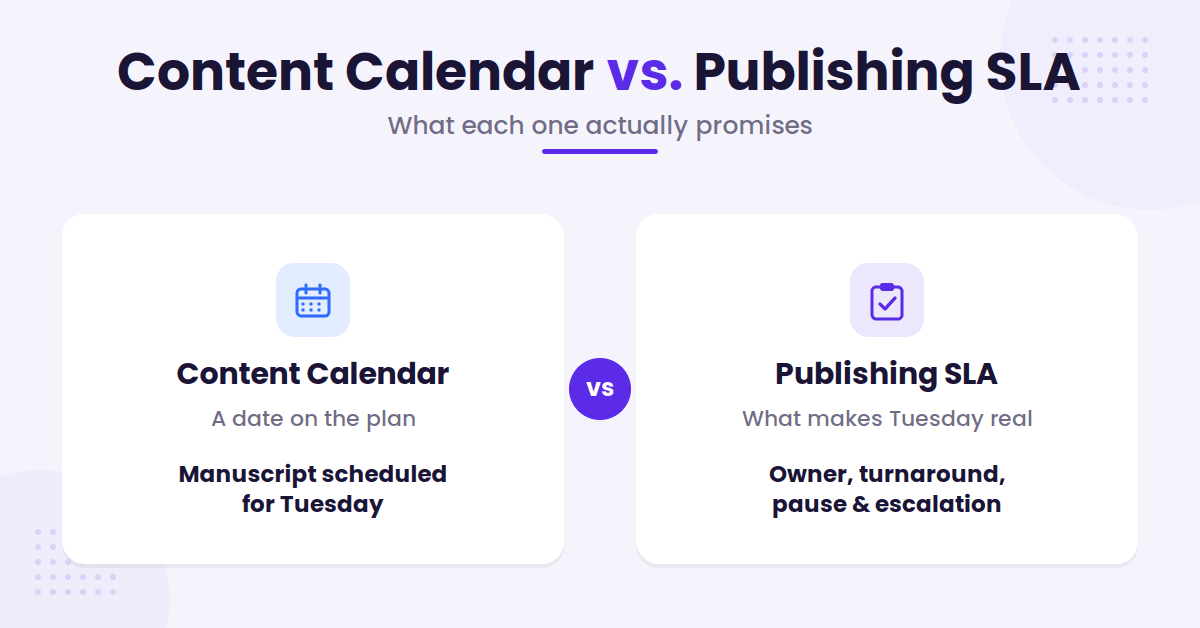
Editing, expert review, revisions, and final approval still need clear timing. Reviewer availability and missing source material are what actually wreck a schedule.
Your SLA should define five things for every stage:
- The event that starts the clock, such as an approved brief or an accepted revision handoff.
- The owner who receives the work, moves it forward, and handles publication decisions.
- The expected turnaround time and the required output.
- The condition that pauses the clock, such as missing source material, an unavailable reviewer, or delayed licensing details.
- The escalation path when a deadline is at risk.
The clock also changes by content type. A product launch may wait on legal sign-off. A customer story waits on the customer. Define explicit start, pause, and stop conditions for each path rather than assuming one timeline covers everything.
A same-day draft is not the same as a same-day publish. Treat drafting speed and publication readiness as two separate promises. This prevents the most common AI workflow problem: a queue full of almost done articles that nobody has time to finish.
Break Publishing Into Measurable Stages
Start with the steps your team already takes. Don’t copy another company’s timeline.
A SaaS feature announcement, a medical topic, and a simple how-to post need very different levels of review.
For a standard evergreen article, a seven-business-day SLA is a sensible starting point:
- Brief approval, one business day. The editor confirms the audience, angle, keyword target, sources, and conversion goal.
- Research and AI draft, one business day. The writer or AI operator gathers sources and produces a draft. The tools genuinely speed up organizing and drafting. They do not replace somebody checking whether the claims hold up.
- Editorial review, two business days. An editor improves the argument, voice, usefulness, and on-page SEO.
- Expert review, two business days. A subject matter expert checks claims that require product, industry, legal, or technical knowledge.
- Revision and final QA, one business day. The editor resolves comments, checks links, adds metadata, and schedules publication.
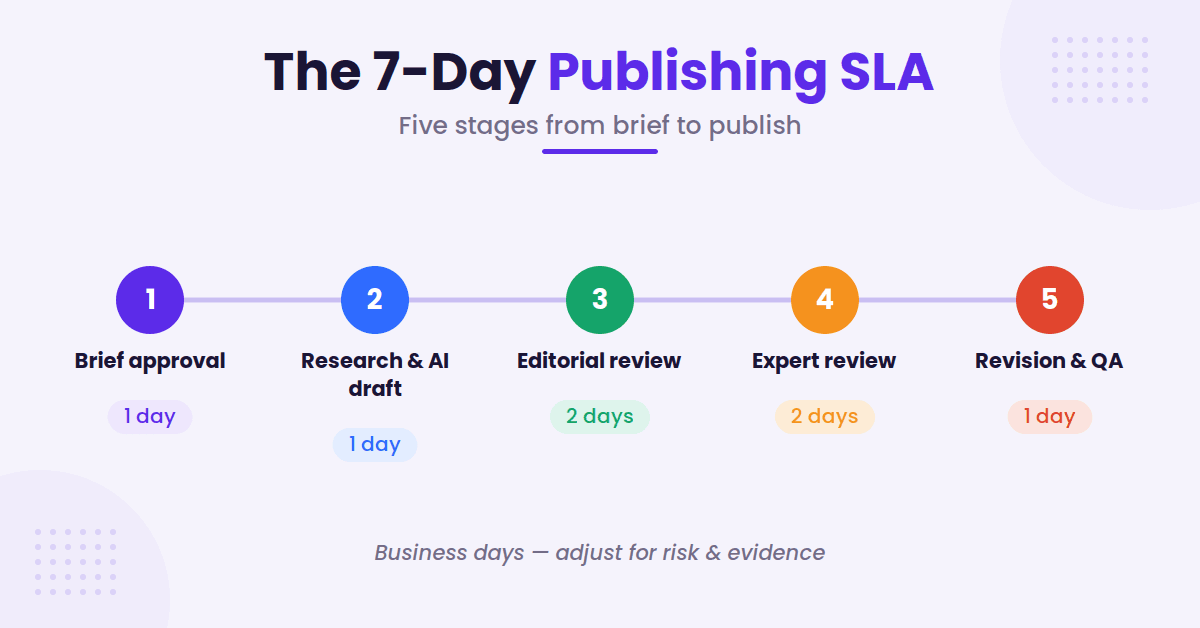
Those timeframes aren’t universal. Risk, evidence requirements, and reviewer availability should set the pace.
Regulated topics raise the bar. Anything touching health, money, or legal claims needs sources a reviewer can actually open and check, and usually a longer review window than your standard post.
A high-stakes article may need ten business days. A news response may need four hours. The important part is that each workflow has a named standard, not an optimistic guess.
If you’re using tools to automate your content publishing schedule, add two clear statuses before anything reaches your CMS: ready for review and approved to publish.
Automation should move work forward. It shouldn’t skip approval.
Pressure to hit a publishing number can create bad incentives. Google’s March 2024 search update made its position plain: mass-produced, low-value pages built for rankings are a problem. Your SLA should reward useful, finished work, not a bigger draft count.
Set Quality Gates That Can’t Be Skipped
A publishing SLA needs a definition of done. Without one, editors and reviewers make different calls every time, and the queue turns into a back-and-forth mess.
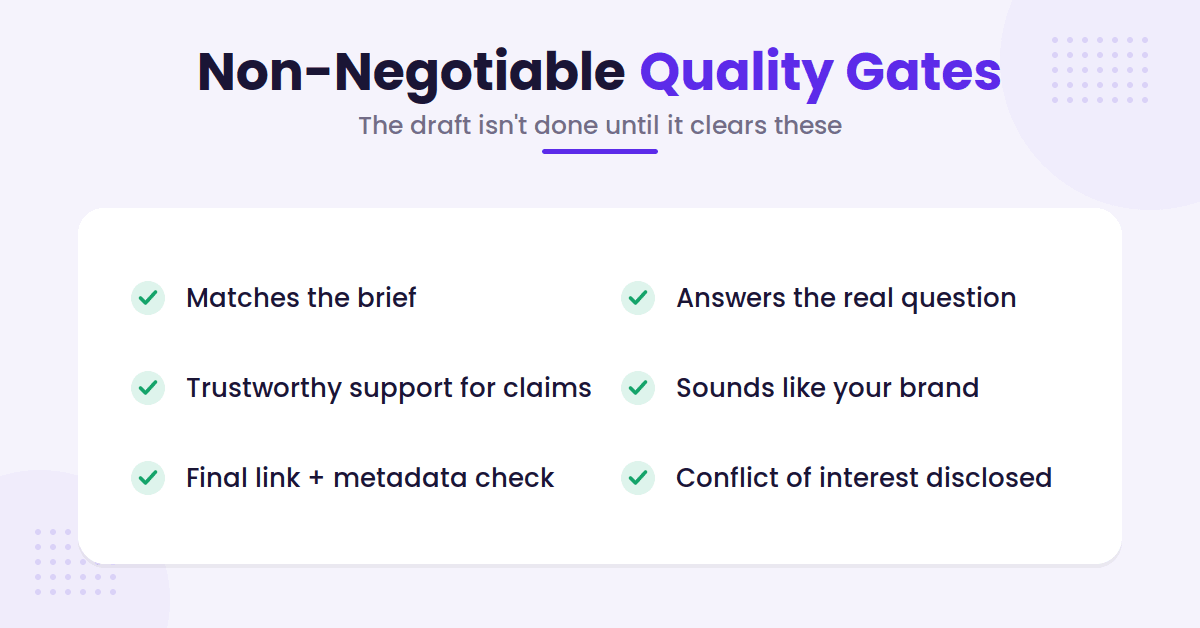
Set a short set of non-negotiable gates. The article should match the brief, answer the searcher’s real question, include trustworthy support for meaningful claims, and sound like your brand.
Any claim carrying a number should be checked for source, scope, and date. A statistic missing those three is a liability, not support.
It also needs a final link check, a working title and meta description, and a clear next step for the reader.
Google’s guidance for generative AI content doesn’t treat AI use as the issue. It focuses on helpful, accurate content created for people.
That’s the standard your reviewers should apply too. An SME check and an edit are different jobs: one asks whether it is true, the other whether it reads.
Don’t make an SME review vague. Give the reviewer the draft, brief, source links, and a deadline. Then ask five focused questions:
- Is this accurate for the current product, process, or regulation?
- Are the product, pricing, and integration details current as of today?
- Does any claim promise more than it can deliver?
- What important limitation, condition, or exception is missing?
- Which statement needs a stronger source or a clearer explanation?
If the SME spots one product error, send the corrected section back for confirmation. Don’t make them reread 1,500 words because one paragraph changed.
Assign Owners, Escalation Rules, and Exceptions
Every handoff needs one accountable person. The content team isn’t an owner. It’s a group of people who can all assume somebody else has the task.
- The content operations lead owns the process and reports missed SLAs.
- The editor owns the finished article.
- The SME owns factual feedback in their area.
- The writer or AI operator owns draft quality and the source trail.
- A final approver owns publication decisions and can approve, hold, or escalate the item.
Write escalation rules before your queue gets busy. If an SME hasn’t replied after two business days, does the editor publish without that review, ask a backup reviewer, or push the deadline?
A short bench of backup reviewers helps, as long as the substitute actually knows the subject. Your answer should depend on content risk, not who’s online that afternoon.
Treat missing inputs as a real status. If a product team hasn’t supplied release details, the review clock should pause.
Record why it paused and who must respond. Otherwise, your SLA data will blame editors for delays they couldn’t control.
Measure the SLA Without Chasing Volume
A healthy SLA makes delays visible. It doesn’t turn people into stopwatch targets.
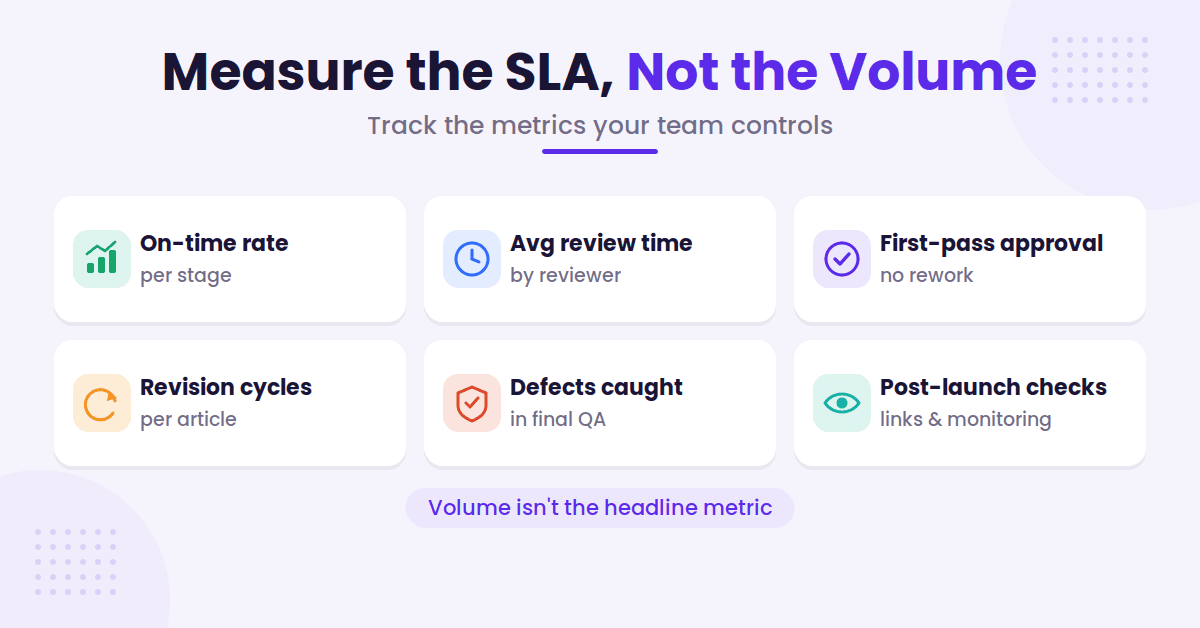
Track your on-time rate for each stage, plus average review time, first-pass approval rate, revision cycles, and defects caught during final QA. If you publish across very different topics, each may deserve its own defect categories and review-time benchmarks.
Also separate publishing performance from search performance. Clicks, impressions, conversions, and post-publish monitoring are a different scoreboard from whether the workflow ran on time. Your team can promise technical quality, correct internal links, and timely monitoring, but not a Google ranking or instant indexation.
A pre-publish gate using SEO reports for content optimization can catch weak headings, missing keyword coverage, and structural issues before a post goes live. Then use the same reporting to assess rankings and reader behavior after publication.
Don’t use raw publishing volume as the headline metric. Google’s spam policies define scaled content abuse as creating many pages mainly to manipulate rankings rather than help users. More posts only help when each one deserves to exist.
FAQs About Publishing SLAs
Here are a few more questions you might have.
What Must Be Ready Before the Clock Starts?
Start the clock only when the brief is genuinely finished. That means a defined audience, a clear angle, the target query, the sources the writer should work from, and what the reader should do at the end.
Agree the turnaround for first feedback before the draft enters review, not after somebody is already waiting on it.
Should the Workflow Promise Rankings or Indexing?
No. Rankings and indexing depend on factors outside your team’s control, including competition, search demand, site authority, and Google’s crawl decisions.
Your workflow can cover work your team controls, such as publication, indexability checks, internal links, metadata, and post-launch monitoring.
How Long Should an SLA Be for a Standard Blog Post?
Seven business days is a reasonable starting point for an evergreen article: one day for the brief, one to draft, two to edit, two for expert review, and one for revisions and final QA.
Treat that as a starting number, not a rule. Time your own stages for a month, then set the SLA from what your team actually does rather than what you wish it did.
What Happens When a Deadline Slips?
Decide in advance, in writing. Either the editor publishes without that review, a backup reviewer picks it up, or the date moves. Which one applies should depend on the risk in the content, not on who happens to be online.
Record the reason for every slip. Without that, your SLA data quietly blames editors for delays they never controlled.
Who Owns Publication Decisions When a Reviewer Misses a Deadline?
The workflow should name a decision owner and include a written fallback. Pause the clock if input is required, assign a backup reviewer, or escalate to the content lead.
Don’t let a post sit in review with no deadline and no owner. That’s not a workflow. It’s a parking lot.
Final Thoughts on Publishing SLAs
AI-assisted drafting removed much of the bottleneck. It didn’t remove the need for expert judgment.
The strongest publishing SLAs make work predictable, protect the review gates that matter, and reveal where delays begin. Your team should move faster because the workflow is clear, not because quality checks disappeared.

Article by
RightBlogger Co-Founder, Andy Feliciotti builds websites and shares insights on AI content, photography, and travel.



Automated SEO Blog Posts That Work
Try RightBlogger for free, we know you'll love it.





Leave a comment
You must be logged in to comment.
Loading comments...