How to Run an AI Content Pilot That Proves Its Value
Test 12 to 20 articles against quality, editing time, factual errors, and search readiness.


Publishing AI-assisted content at volume before testing it is how teams create expensive cleanup work for your marketing team. A focused AI content pilot gives you proof about quality, workload, search readiness, and risk before dozens of drafts hit your queue.
The goal isn’t to prove that AI can write. It can. The real question is whether it can support your editorial standards and fit into your broader content strategy without creating more work for your editors.
Start small, put clear guardrails in place, and collect evidence your stakeholders can trust.
Key Takeaways for an AI Content Pilot
- Pick one repeatable content type with manageable risk, not your most important revenue pages.
- Test the entire content production workflow, including research, editing, approvals, publishing, and post-publish checks.
- Use the same quality rubric for human-written and AI-assisted work, or the comparison won’t mean much.
- Track editing time and factual errors alongside traffic signals. Fast drafts don’t matter if revisions eat the savings.
- Scale only after you have a workflow content creators can follow without guessing.
How to Scope an AI Content Pilot That Produces Useful Evidence
A pilot needs a tight boundary. Let’s use AI for content isn’t a boundary. It’s an invitation for every department to test something different, then argue about what worked.
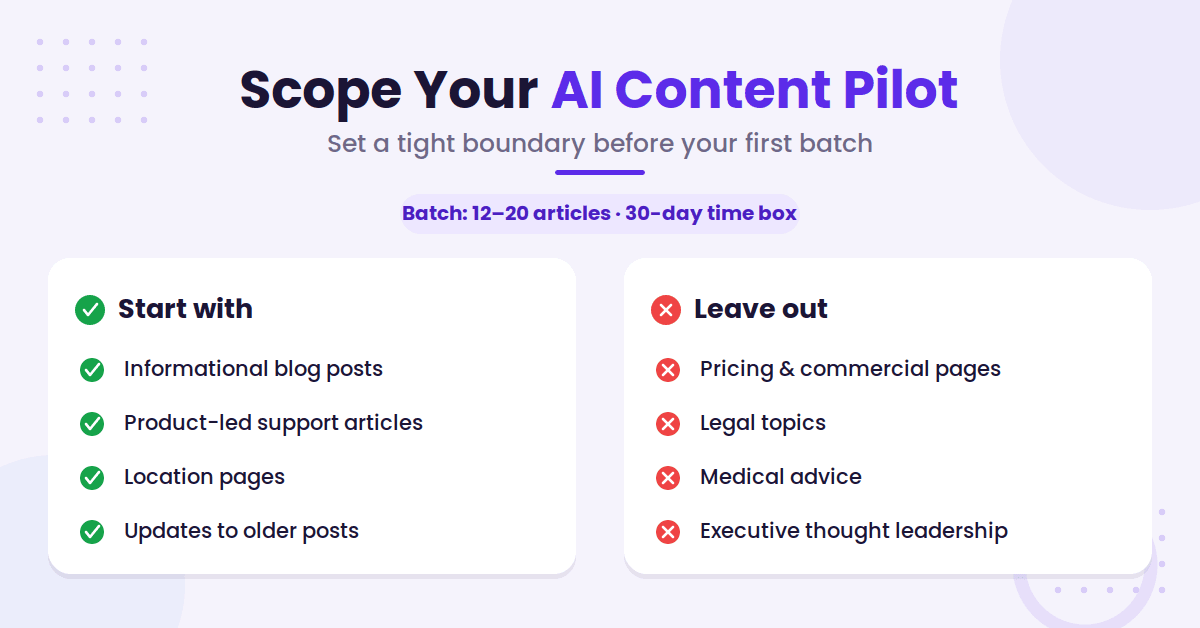
Choose one content format that your team already understands. It could be informational blog posts, short social media content, LinkedIn content, product-led support articles, location pages, or updates to older posts. Pick work with clear inputs and a repeatable finish line.
For most editorial teams, a batch of 12 to 20 articles is enough to reveal the pattern. You will see where briefs fail to define the target audience, which prompts produce weak claims, and how long editing actually takes.
Leave high-risk content out of the first batch. Don’t begin with pricing pages, legal topics, medical advice, executive thought leadership, or your biggest commercial pages. Those pages need more brand judgment and more careful source review.
Set a short written hypothesis before work starts. For example: AI-assisted first drafts will cut time to an editor-approved article by 30%, while meeting our existing quality threshold. That gives the pilot something real to test.
Also establish a comparison point. Pull five to 10 recently published articles in the same format, ideally ones that started from comparable briefs.
Record their production time, number of edits, performance, and common reviewer feedback. Without that baseline, a shiny new workflow can look better than it is.
Thirty days makes a useful time box. It is long enough to run a real batch, and short enough to stop bad habits before they spread.
A pilot should test a production system, not a writing tool in isolation.
Build a Small, Reviewable Production Workflow
The fastest way to ruin an AI content pilot is to let each writer invent their own process or use an AI writing assistant without clear guidelines.
One person uses detailed source notes. Another asks for a full article in one prompt. A third publishes after a light skim.
Soon, you’re comparing three separate workflows.
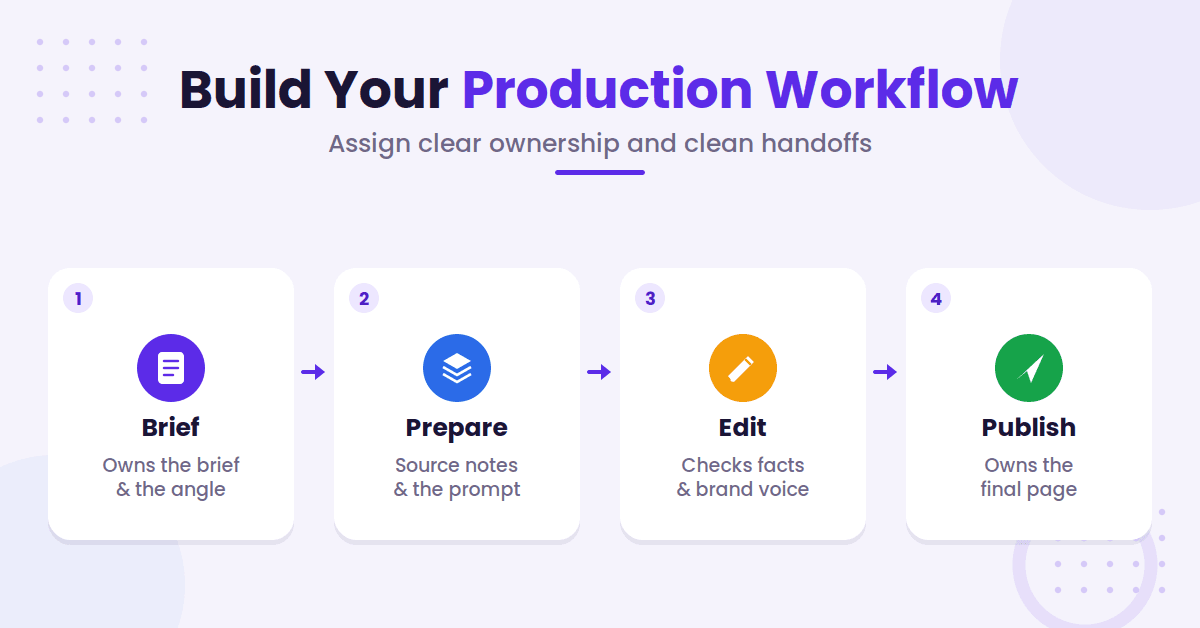
Assign clear ownership instead. You need:
- someone responsible for the brief
- someone who prepares the source material and prompt
- an editor who checks facts and brand voice, which is where a subject-matter expert review queue earns its place
- a publisher who owns the final page
One person can hold more than one role on a small team. The handoffs still need to be clear.
Give every pilot article the same inputs:
- A target query and the reader’s underlying question
- A short brief with the audience, angle, internal product context, and exclusions
- Approved sources, data, and subject-matter notes
- A defined point of view or brand voice examples the draft should follow
- An editorial rubric that states what ready means
AI can produce inaccurate claims with total confidence. Treat every generated statistic, quote, product detail, and source citation as unverified until a human checks it. If the draft cannot point to a credible source, cut the claim or research it properly. A set of AI fact-checking tools speeds this up, but it does not replace the human pass.
Your team will get more reliable results by separating research, outlining, drafting, and editing. Asking a model to perform all four in one pass often creates a polished-looking draft with weak foundations.
A complete AI content creation workflow can help you map those stages. Keep the pilot hands-on at the approval points. Automation should remove repetitive work, not remove accountability.
Don’t publish directly from a generation tool during the test. Use a staging or draft state within your content platform, review every change, and keep independent backups of your site. Reversible publishing features are useful, but they are not a disaster-recovery plan.
Measure Quality, Cost, and Search Readiness
Traffic is a lagging signal. If you wait for rankings before judging the pilot, the team may have already spent weeks repeating a broken process.
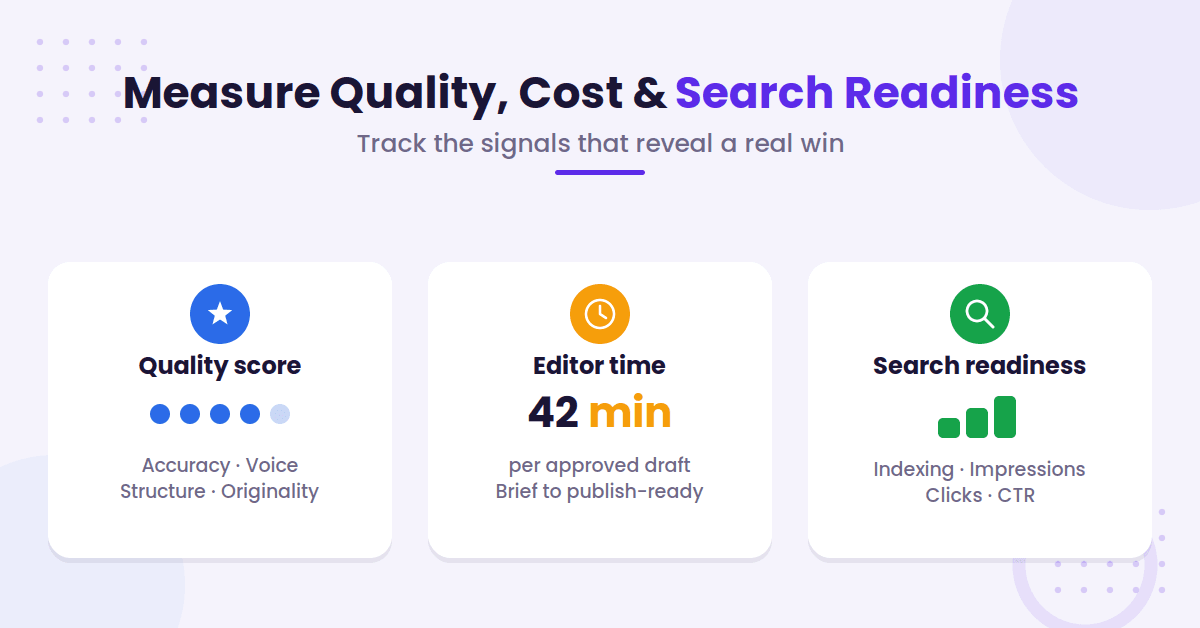
Track editorial quality while the work is happening. Use a simple one-to-five score for factual accuracy, usefulness, brand voice, structure, and originality. Ask editors to note why they changed something, not only that they changed it.
Then track the operational side. Measure time from brief to approved draft, editor minutes per article, number of fact corrections, and cost per publish-ready piece. A quick first draft isn’t a win when it takes an editor two hours to rebuild it.
If a draft needs a new outline, fresh research, and a full rewrite, it wasn’t an AI-assisted win. It was a rough idea with a hidden production bill.
After publishing, review Google Search Console data for indexing, impressions, clicks, query relevance, and click-through rate. A page that is crawled but not indexed isn’t automatically a penalty. Still, it’s a reason to inspect whether the page offers enough original value to deserve a place in search.
Pay close attention to pages that earn impressions but weak clicks. The title may miss the searcher’s intent, or the answer may arrive too late. For question-led articles, put a direct answer near the top to improve your odds of winning a featured snippet, then support it with useful detail.
Governance belongs in the results too. A pilot report that only counts articles produced skips the questions leadership will actually ask: who approved what, which sources were checked, and what happens when a draft fails review. Record those alongside the volume numbers.
Decide Whether the Pilot Can Scale
Don’t make a scale decision based on average results alone. Look for consistency. If three articles are excellent and nine need a heavy rebuild, your system is not ready yet.
An AI content pilot can move forward when reviewers hit the quality bar consistently, editing time falls or stays predictable, and the team can explain the workflow without relying on one power user. You also need a clear source policy and a record of the prompt patterns that worked.
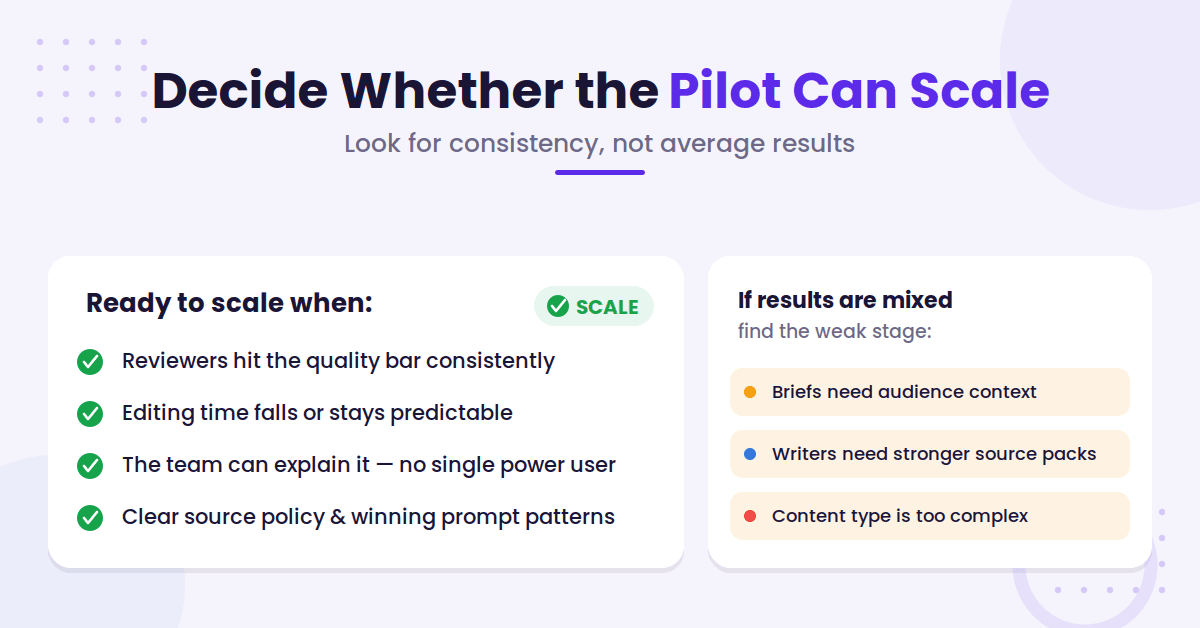
If results are mixed, don’t scrap the whole effort. Find the weak stage.
Maybe briefs need better audience context. Maybe writers need stronger source packs. Maybe the tool is fine, but the chosen content type needs too much subject-matter expertise.
Teams that move from a pilot into a real program tend to do it by narrowing, not broadening. They pick the one or two formats the test proved out and run those at volume, rather than declaring AI approved for everything.
Write down the approved workflow before you expand it. Include the brief template, research rules, prompt guidance, review rubric, publishing controls, and escalation path. That document is what turns a successful test into repeatable work.
FAQs About an AI Content Pilot
Here are a few additional questions you might have about running an AI content pilot.
How Long Should an AI Content Pilot Last?
A 30-day AI content pilot works well for many teams because it creates urgency without forcing a rushed verdict. Keep tracking search data after the pilot ends, since indexing and the impressions that follow it can take longer to develop.
How Many Articles Should We Include in an AI Content Pilot?
Start with 12 to 20 articles in one content type. That gives your AI content pilot enough volume to reveal recurring problems while keeping the review workload manageable.
Can We Publish AI-Assisted Articles During the Pilot?
Yes, if each article passes the same editorial, fact-checking, and approval standards as other content. Publish in a controlled batch, review the pages after launch, and keep backups before making any automated site changes.
Final Thoughts on Running an AI Content Pilot
The safest way to scale AI-assisted publishing is to earn the right to scale it. Whatever format you start with, a focused pilot exposes the edits, risks, and bottlenecks that a demo never shows.
Treat quality control as part of production, not the final hurdle. You’ll build a content system your editors can trust, and your readers will still recognize.

Article by
RightBlogger Co-Founder, Ryan Robinson is a creator and recovering side project addict who teaches 500,000 monthly readers to grow an online business.




Automated SEO Blog Posts That Work
Try RightBlogger for free, we know you'll love it.





Leave a comment
You must be logged in to comment.
Loading comments...