9 Best LLM SEO Tools in 2026: AI Visibility Trackers Compared
AIclicks gives solo creators prompt-level visibility across their most important AI search engines.


Let’s cut straight to it: If I had to pay for just one of the LLM SEO tools out there, I’d pick AIclicks for most bloggers and content creators. It gives me the clearest answer to the one thing that matters now: my AI visibility. Am I showing up inside AI answers or not?
That’s the real split in this market. Some tools help you write better posts. Others tell you whether ChatGPT, Gemini, Perplexity, and Google AI Overviews are actually surfacing your brand in AI answers. This guide covers the second group, the trackers, and compares 9 of them on price, prompts, AI engines covered, and how often they check, with every price re-checked on the vendor’s own pricing page in November 2026.
Key Takeaways
- ✍️ AIclicks is my best overall pick for tracking AI visibility: $59/month for 30 prompts checked daily.
- 📊 LLMrefs gives the best value if I manage multiple sites or clients, with every major AI engine included for $79/month.
- 💸 Otterly.AI is the cheapest dedicated tracker at $29/month, and Peec AI goes deepest on which sources AI cites.
- 🔎 Semrush and Ahrefs now sell AI tracking alongside their SEO suites. Use them if you already pay for one, but I wouldn’t subscribe just for LLM tracking.
- 🆓 You can start free: Google Search Console, Bing Webmaster Tools, and free checkers from Ahrefs and RightBlogger all show some AI visibility data.
What Is an LLM SEO Tool?
An LLM SEO tool tracks whether AI assistants like ChatGPT, Gemini, Perplexity, and Google AI Overviews mention or cite your brand, and shows which competitors and sources they pick instead.
You’ll see the same category called AI visibility tools, LLM trackers, GEO (generative engine optimization) tools, or AEO tools. They all do the same core job. You give the tool a list of prompts, the questions your buyers ask AI, and it runs them on a schedule and records who gets named, in what position, with what sentiment, and which pages get cited as sources.
One naming note: “LLM SEO tool” sometimes means the AI model you write SEO content with. That’s a different question. This guide is about measuring your visibility inside AI answers. If you want the strategy side first, start with our guide to Generative Engine Optimization or our GEO vs SEO breakdown.
Quick Picks: The Best LLM SEO Tool for Each Job
- Best overall for bloggers: AIclicks
- Best for agencies and multi-site tracking: LLMrefs
- Best budget tracker: Otterly.AI
- Best for citation and source analysis: Peec AI
- Best for enterprise brands: Profound
- Best if you already pay for an SEO suite: Semrush or Ahrefs
- Best for pairing tracking with content optimization: Surfer
- Best if you already use RightBlogger: AI Brand Monitor
Quick Comparison: LLM SEO Tools at a Glance
| Tool | Cheapest paid plan | Prompts on that plan | AI engines on that plan | Checks |
|---|---|---|---|---|
| AIclicks | $59/mo | 30 | Pick 3 (ChatGPT, Gemini, Perplexity, Claude, Copilot, AI Overviews, AI Mode, Grok, and more) | Daily |
| LLMrefs | $79/mo | Keyword-based (prompts generated from your keywords) | All: ChatGPT, AI Overviews, AI Mode, Gemini, Perplexity, Claude, Grok, Copilot, Meta AI, DeepSeek | Weekly |
| Otterly.AI | $29/mo ($25/mo billed yearly) | 15 | ChatGPT, AI Overviews, Perplexity, Copilot (Gemini and AI Mode +$9/mo each, Claude +$29/mo) | Daily |
| Peec AI | $95/mo | 50 | Pick 3 of ChatGPT, Gemini, Copilot, AI Overviews, AI Mode (Perplexity is a paid add-on) | Daily |
| Profound | Custom (Enterprise); free 7-day trial | 50 preset prompts on the trial | Trial: ChatGPT, Gemini, AI Overviews. Enterprise: up to 9 engines | Daily |
| Semrush | $99/mo (AI Visibility Toolkit, per domain) | 25 | ChatGPT, Google AI, Gemini, Perplexity | Daily |
| Ahrefs | $129/mo (Lite) | 5 custom prompts | Brand Radar custom prompts; the full Brand Radar AI index is from $199/mo extra | Daily |
| Surfer | $82/mo billed yearly (AI Search Analytics) | 50 | ChatGPT, Gemini, Perplexity, AI Overviews, AI Mode | Daily |
| RightBlogger AI Brand Monitor | Included from $49/mo billed yearly ($59 monthly) | 25 checks per site per month | ChatGPT, Gemini, Perplexity, Claude, AI Overviews | Daily, weekly, or monthly per platform |
Prices checked November 1, 2026 on each vendor’s pricing page, on monthly billing unless noted. AI search tools change their plans often, so confirm the current price before you buy.
Update (October 2026): we removed Miniloop from this list. It previously offered an SEO workflow tool, but it now builds custom CRM software instead.
What Makes an LLM SEO Tool Worth Paying For
The table above gives you the quick view. Here is what to actually look for when you are deciding which tool deserves your money.
A good LLM SEO analysis tool should tell you which prompts trigger your brand mentions, which AI search engines include those mentions, which competitors beat you, and what source citations those systems seem to trust.
You also want stable data. Random one-off prompt checks are fun, but they don’t help you plan content. AI answers change from one run to the next, so a tool that checks the same prompts on a schedule and shows the trend is worth far more than a single snapshot.
Before you compare prices, check these four things:
- Engines: which AI platforms are on the plan you’d actually buy, not the top tier
- Prompts: how many questions you can track, and whether that limit is per engine
- Frequency: daily, weekly, or monthly checks, which decides how fast you’ll see a change
- Sources: whether it shows the pages AI cites, since those are the pages you need to be on
One more thing: content structure still counts. If your post is messy, thin, or vague, no tracking tool can save it. Fix weak structure with an AI SEO Editor or improve answer-ready formatting with an Answer Engine Optimizer before paying for a tracker.
The 9 Best LLM SEO Tools in 2026
1. AIclicks: Best Overall
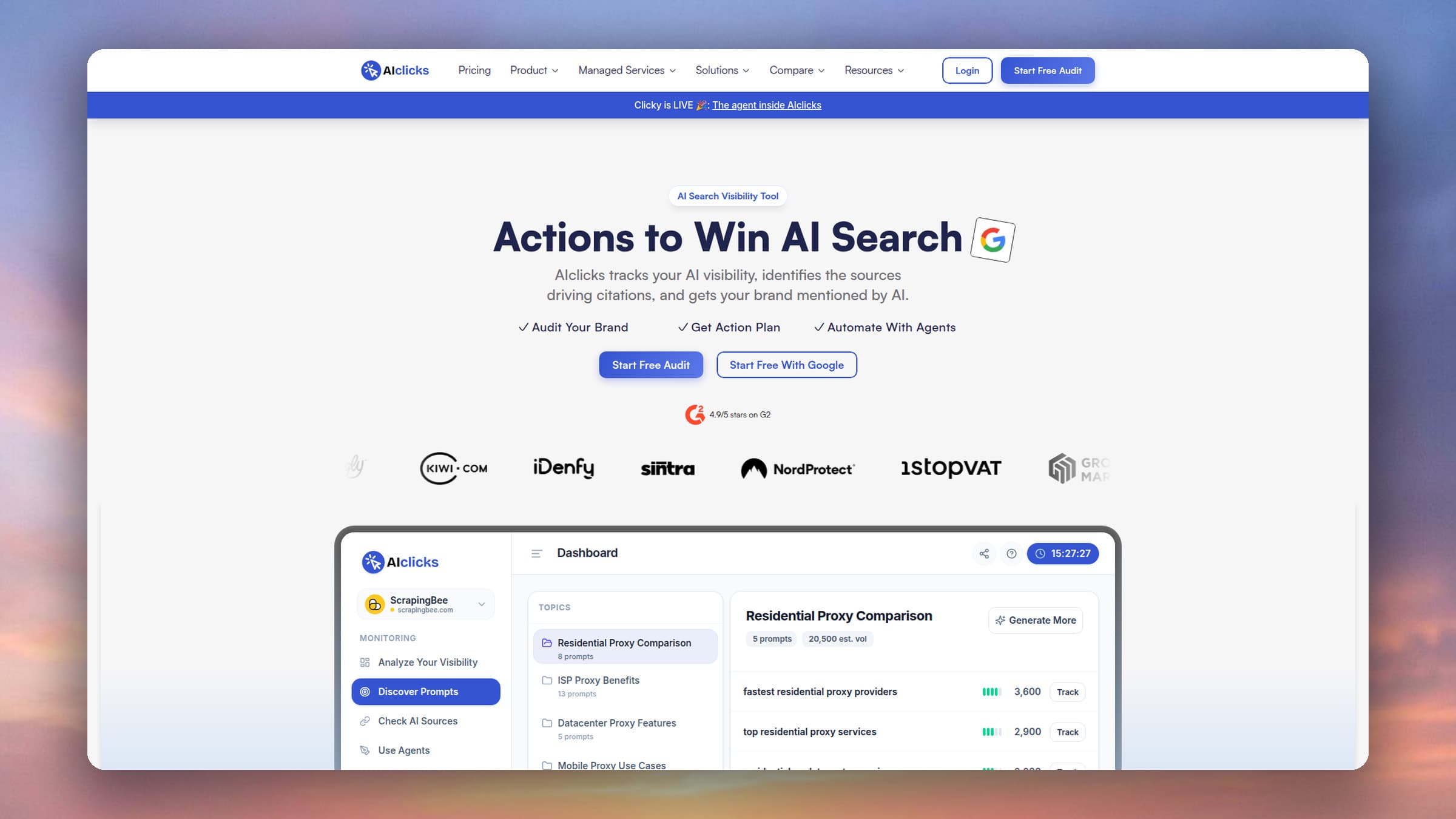
For most bloggers, AIclicks is the best balance of focus, usability, and price in LLM tracking software. Starter is $59/month on monthly billing for 30 prompts on one website, checked daily, and AIclicks advertises up to 29% off on yearly billing. There’s a 3-day free trial, and it needs a card.
What I like most is the prompt-level view. You can see which questions lead to mentions and source citations across ChatGPT, Gemini, Perplexity, Claude, Copilot, Google AI Overviews, AI Mode, Grok, and more. Starter tracks 3 engines of your choice, Pro ($189/month) tracks 4, and Business ($499/month) tracks 6. That turns “AI visibility” into something concrete.
Skip it if you need every engine on the cheapest plan, or if you want to try it without a card. LLMrefs covers both.
2. LLMrefs: Best for Agencies
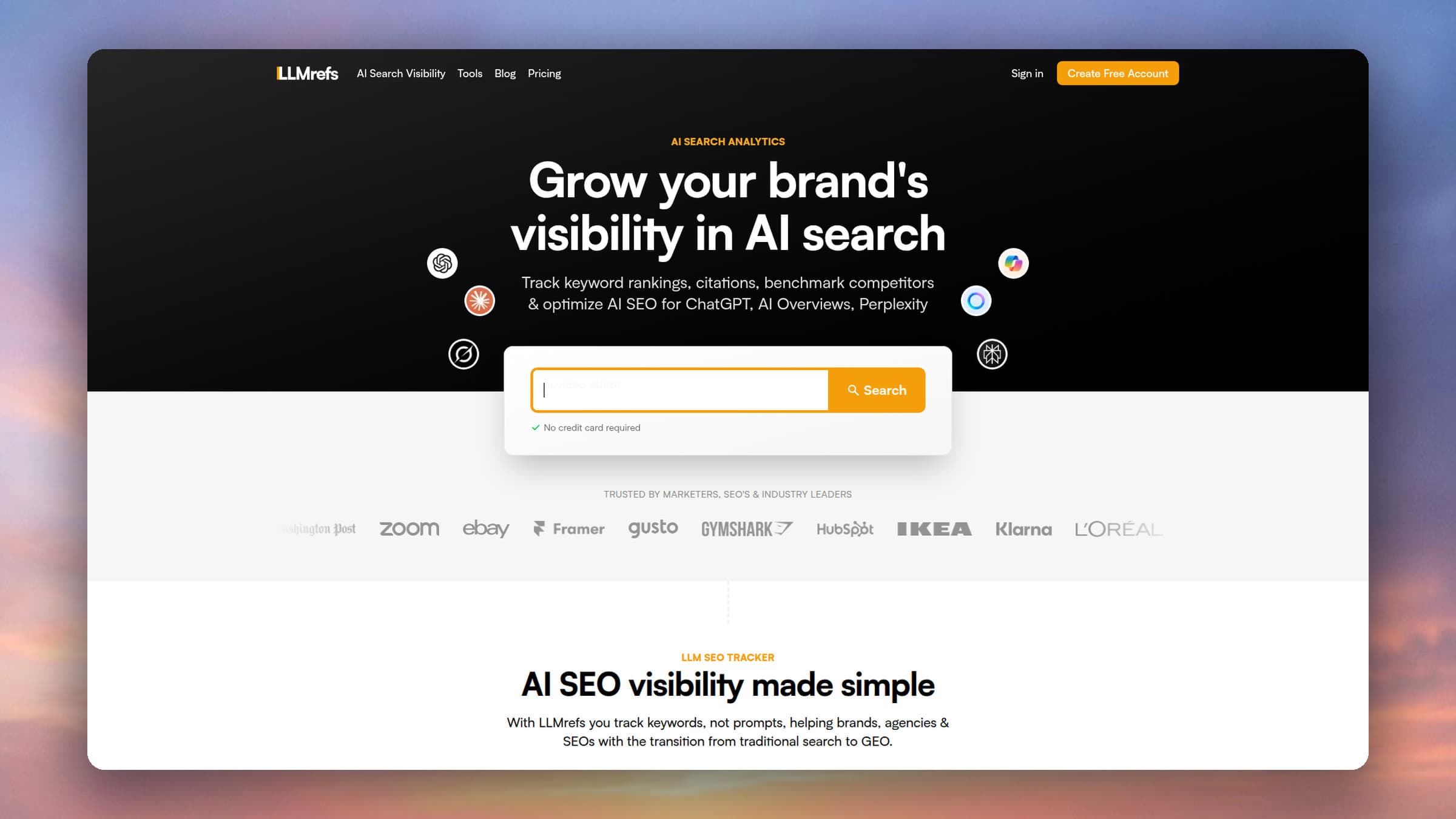
If I ran several client sites, I’d lean toward LLMrefs. Its All in One plan is $79/month (marked as limited-time pricing in November 2026), with unlimited projects and team members, and you can try it for 7 days without a card.
Its biggest strength is scale. Instead of making you write prompts one by one, it tracks keywords and generates the prompts from them, then reports share of voice across ChatGPT, AI Overviews, AI Mode, Gemini, Perplexity, Claude, Grok, Copilot, Meta AI, and DeepSeek, with geo-targeting in 50+ countries. Every engine is included at no extra cost.
Skip it if you need daily data: reports update weekly. For a solo blogger, it’s probably more than you need. For an agency, it makes a lot of sense.
3. Otterly.AI: Best Budget Tracker
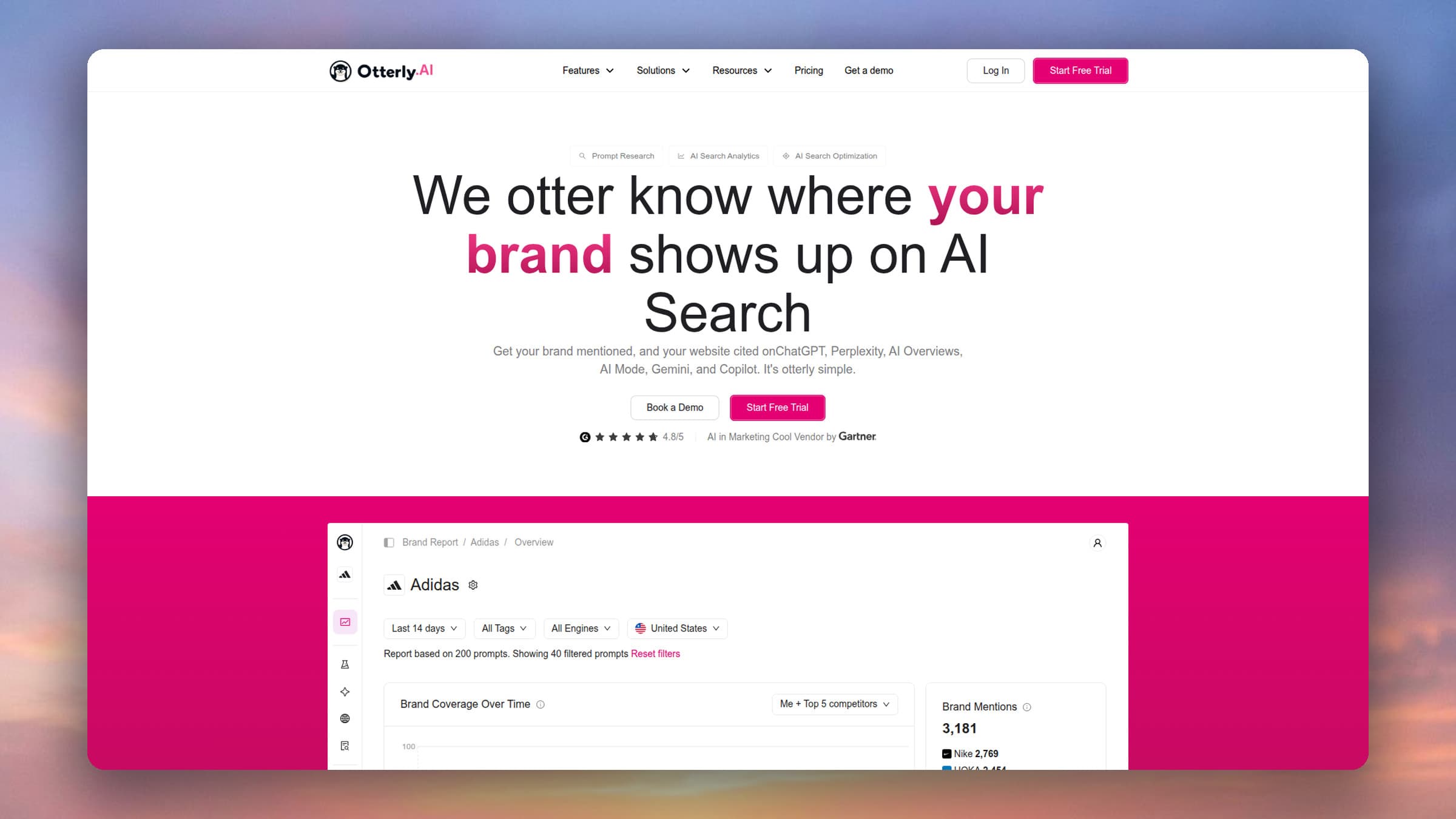
Otterly.AI is the cheapest dedicated tracker in this list. Lite is $29/month, or $25/month billed yearly, for 15 prompts checked daily on ChatGPT, Google AI Overviews, Perplexity, and Copilot.
Gemini and AI Mode are $9/month add-ons, and Claude is $29/month. Lite also includes sentiment and citation-source tracking plus a GEO audit, with unlimited team members.
Best for a first paid tracker on a tight budget. Skip it if you need more than 15 prompts, or Gemini and Claude without add-ons, since the add-ons quickly close the price gap with the tools above. The Looker Studio connector and API start on the $189/month Standard plan.
4. Peec AI: Best for Citation Analysis
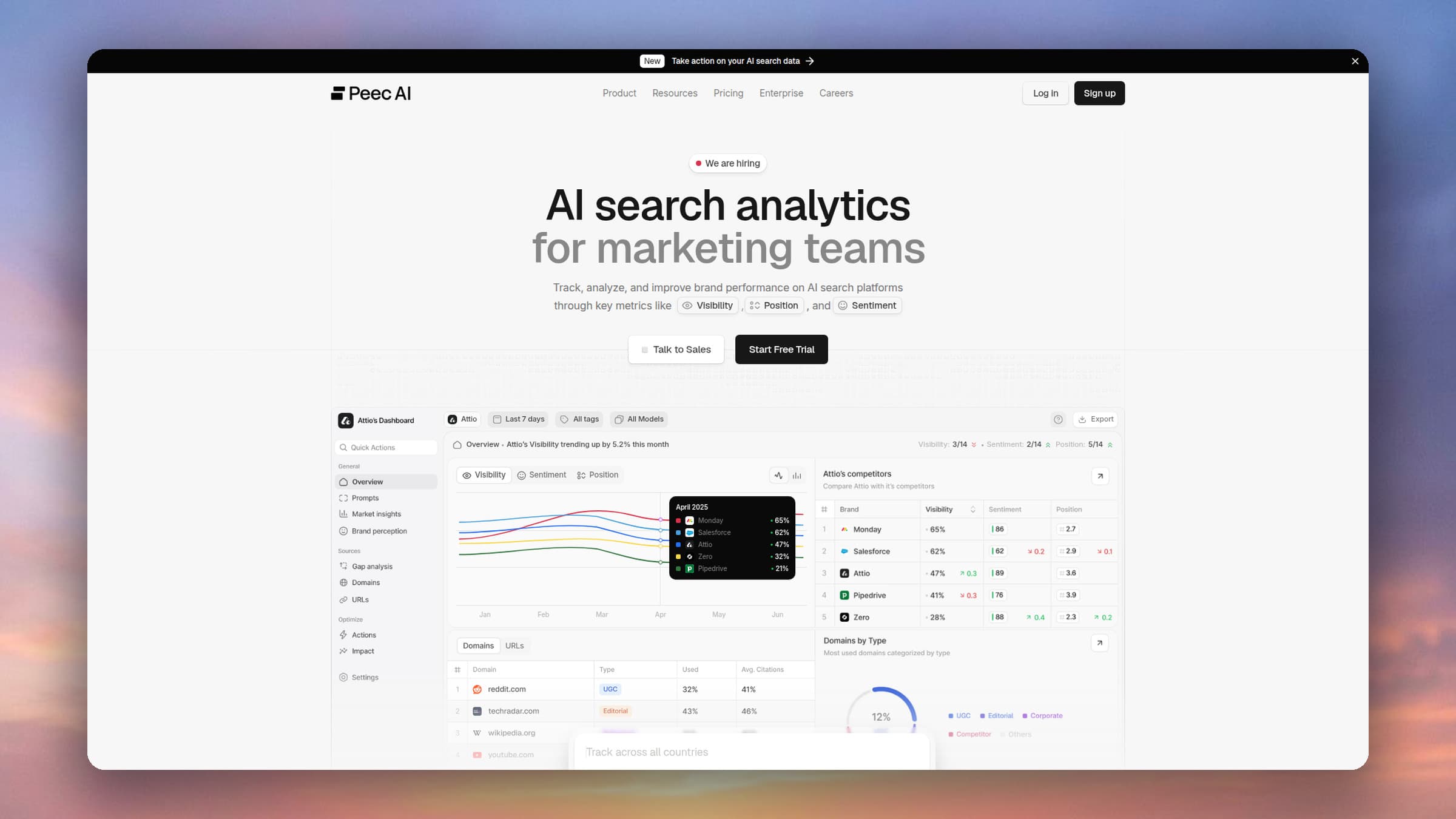
Peec AI focuses on the sources behind AI answers. Its Starter plan is $95/month for 50 prompts checked daily, with unlimited users, and annual billing takes 15% off.
You pick 3 engines from ChatGPT, Gemini, Copilot, Google AI Overviews, and AI Mode. Perplexity is a paid add-on, and Claude is enterprise-only. Its standout features are source and citation analytics with gap analysis, and a check of AI answers against facts you set about your brand.
Best for marketing teams that want to know which pages to get onto. Skip it if you need Perplexity or Claude on a small budget. The API starts on the $245/month Pro plan.
5. Profound: Best for Enterprise Brands
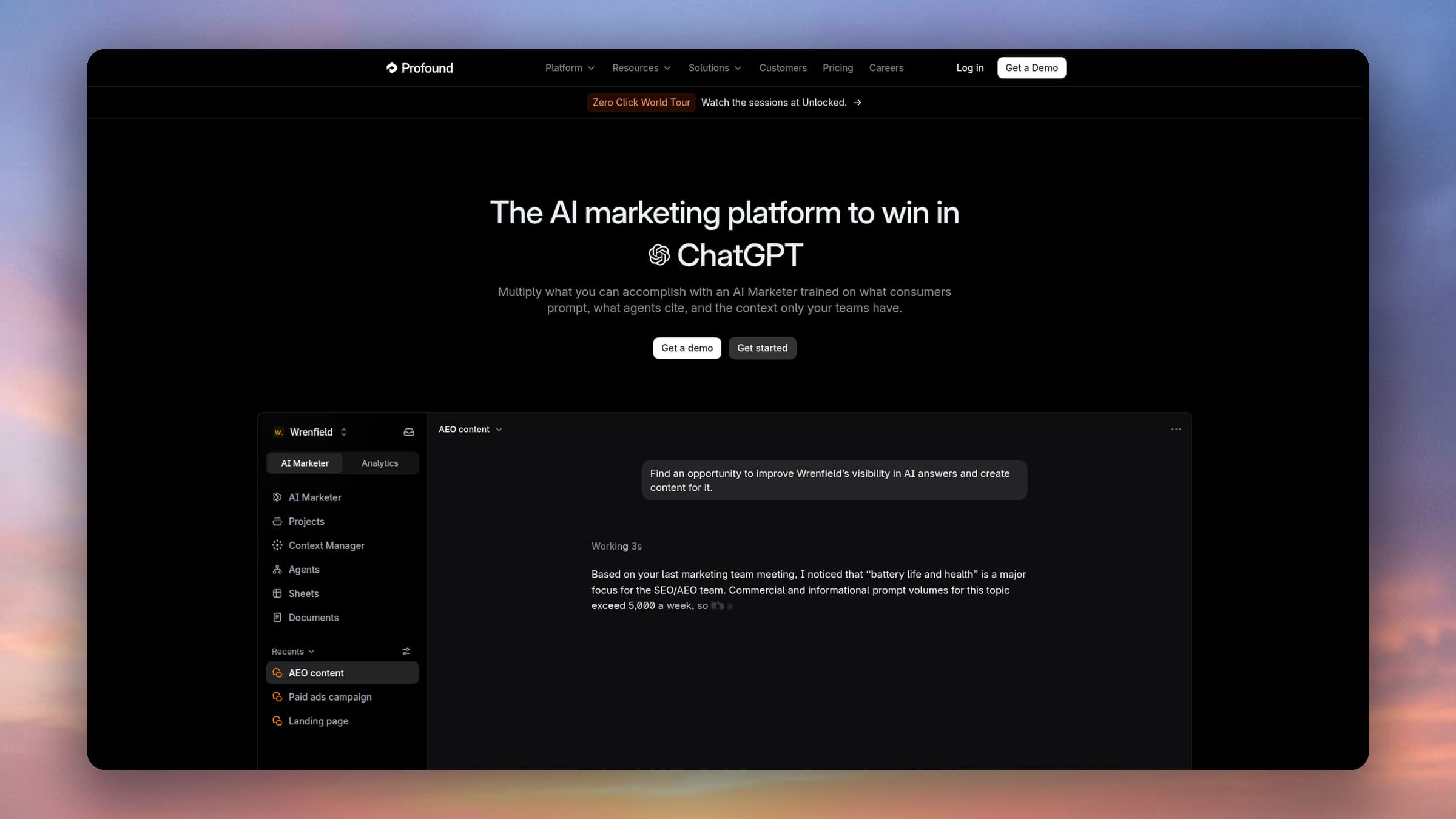
Profound is built for large marketing teams. As of November 2026 it has no self-serve paid plan for brands: there’s a free trial and custom-priced Enterprise.
The free trial runs 50 preset prompts daily for 7 days on ChatGPT, Gemini, and Google AI Overviews. You can’t customize those prompts, and there’s no history or export. Enterprise covers up to 9 engines and adds an AI marketing agent, prompt volume data, and ChatGPT Shopping tracking.
Best for enterprise brands with a budget for a sales-led tool. Skip it if you’re a blogger or small business: the trial is useful for a free look, but you can’t buy a small plan.
6. Semrush: Best If You Already Use Semrush
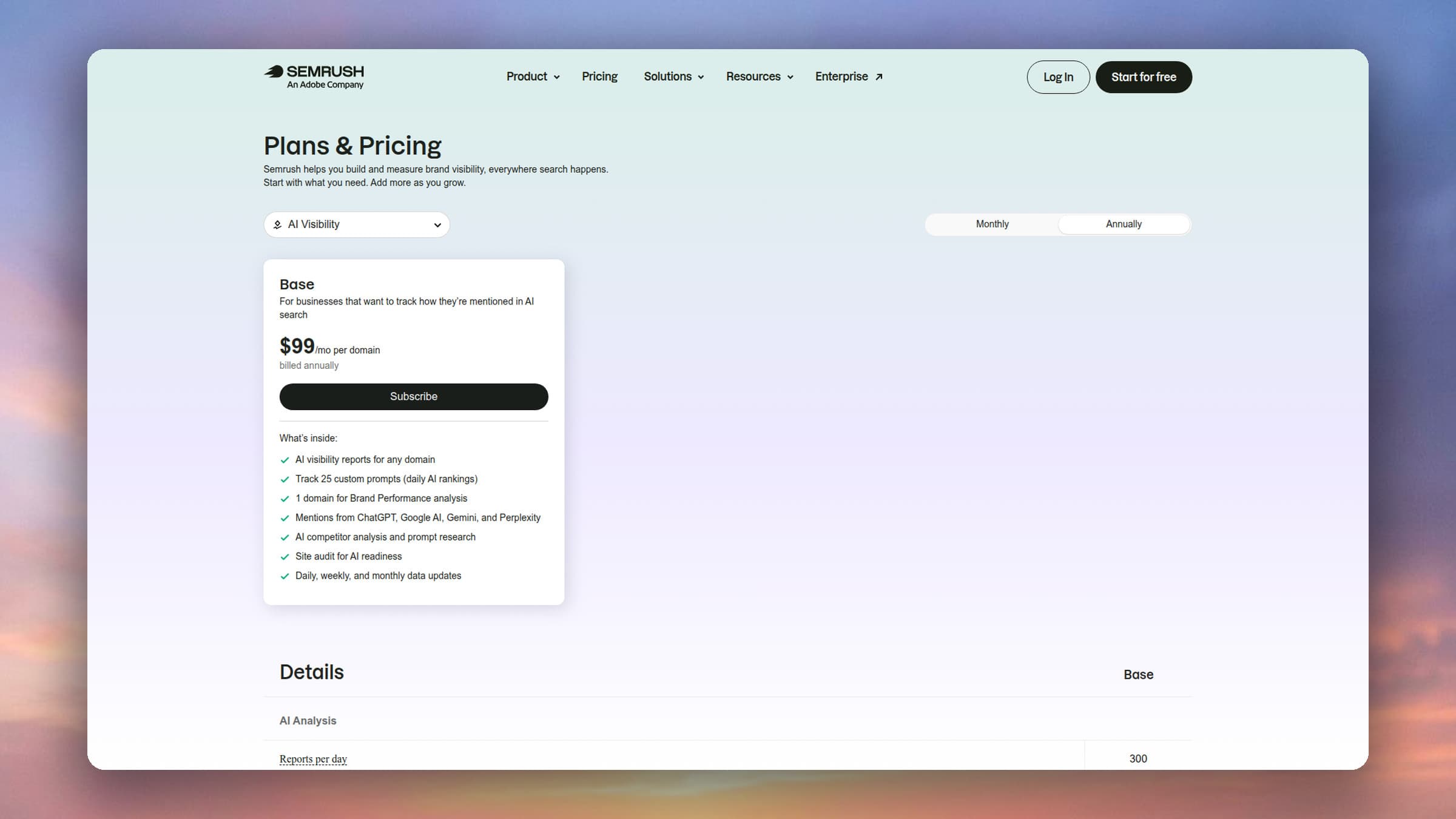
Semrush now sells AI tracking two ways. The AI Visibility Toolkit is $99/month per domain for 25 prompts tracked daily across ChatGPT, Google AI, Gemini, and Perplexity. Its combined SEO and AI search plans start at $199/month with 50 prompts tracked daily.
Semrush still does important work for keyword research, backlinks, and content opportunities. If you already pay for it, the AI Visibility Toolkit is the easiest place to start, and new users can try Semrush free for 7 days.
Still, I wouldn’t buy Semrush just for LLM SEO. For tracking alone, Otterly covers as many engines for less than a third of the price, and LLMrefs covers every major engine for $79/month.
7. Ahrefs: Best for Brand Research at Scale
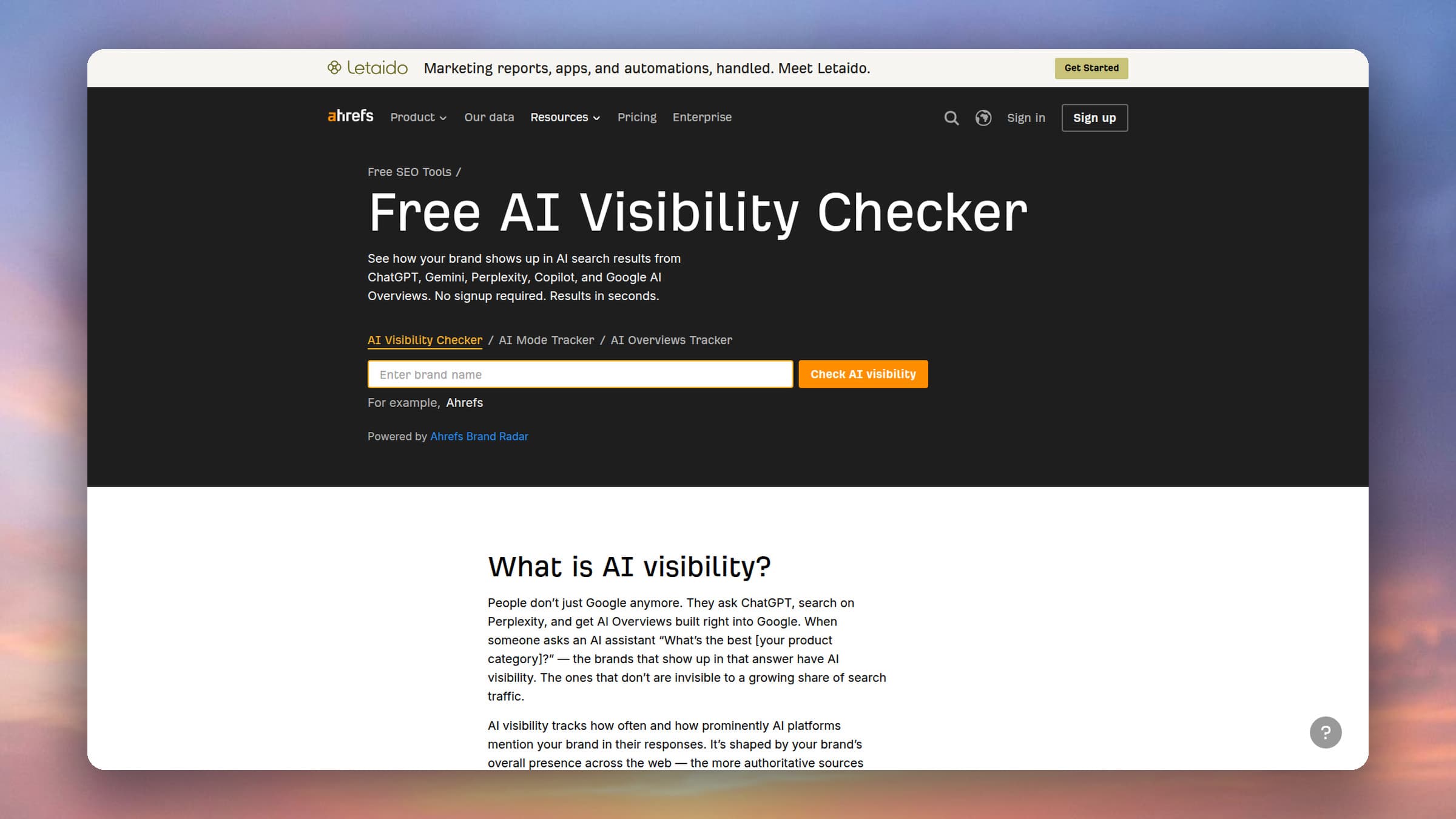
Ahrefs puts its AI tracking in Brand Radar. Every paid plan includes some custom prompts: Lite at $129/month covers 5 prompts updated daily. The full Brand Radar AI index, which shows answers to millions of prompts you didn’t write, starts at $199/month extra.
Ahrefs also sells standalone prompt packs from $50/month, and its free AI Visibility Checker (more on that below) needs no signup. There’s no free trial on paid plans.
Best for SEO teams already in Ahrefs who want to research a whole category, not just their own prompts. Skip it if you only need to track a few dozen prompts: 5 on Lite is very limited, and the Brand Radar AI add-on more than doubles the cost.
8. Surfer: Best for Tracking Plus Content Optimization
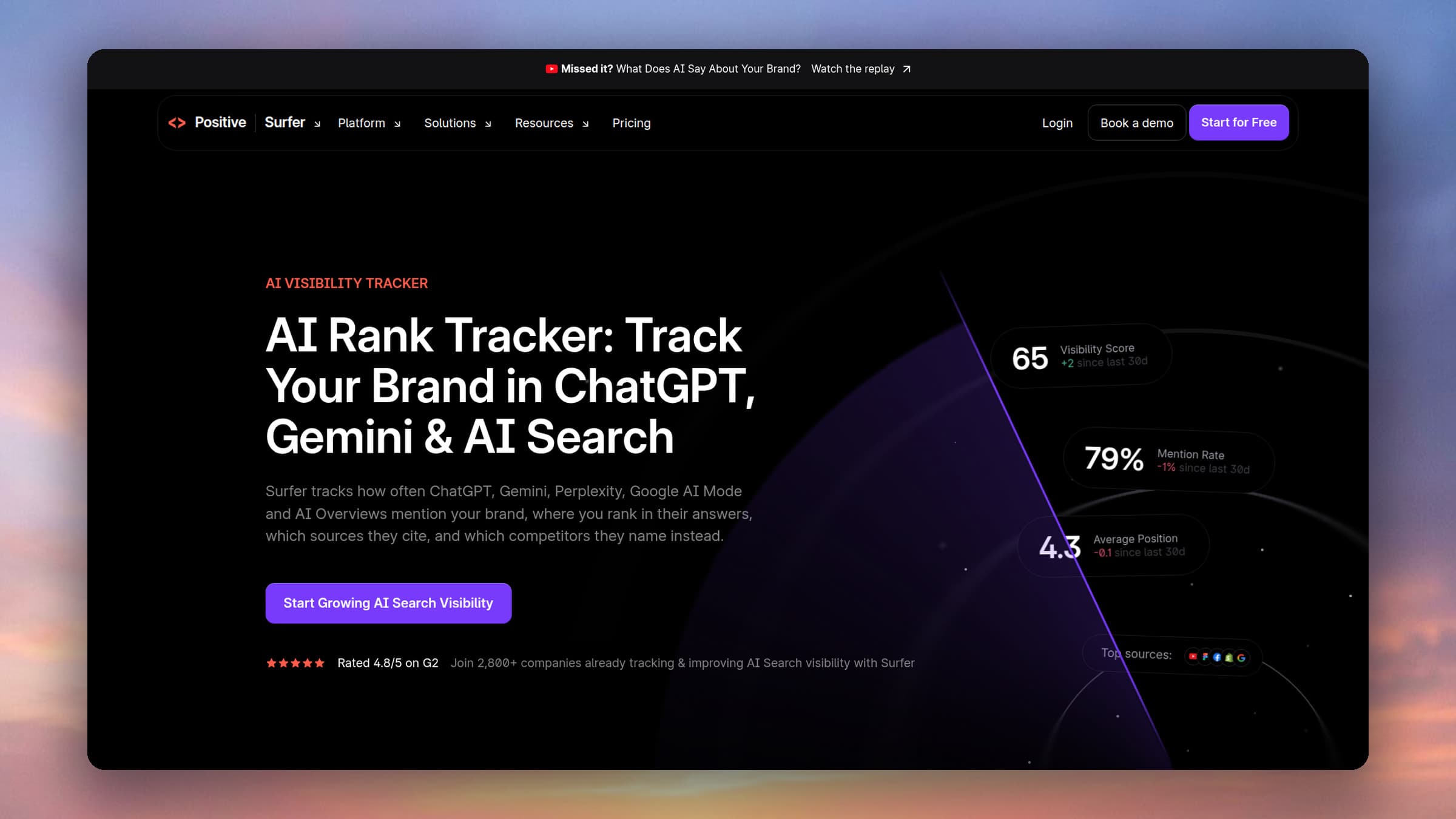
Surfer is mainly an on-page optimization tool, but it now tracks AI visibility too. As of November 2026, its cheapest Discovery plan no longer includes AI tracking. Standard ($99/month billed yearly) includes the AI Tracker with 25 prompts checked weekly in ChatGPT only.
For full coverage, Pro ($182/month billed yearly) or the standalone AI Search Analytics plan ($82/month billed yearly) tracks 50 prompts daily across ChatGPT, Gemini, Perplexity, AI Overviews, and AI Mode, with mention gaps and sentiment.
Best for writers who already optimize drafts in Surfer. Skip it if you only want tracking: dedicated tools cover Claude, Copilot, and Grok, which Surfer doesn’t list.
9. RightBlogger AI Brand Monitor: Best for RightBlogger Users
Disclosure: RightBlogger is our product.
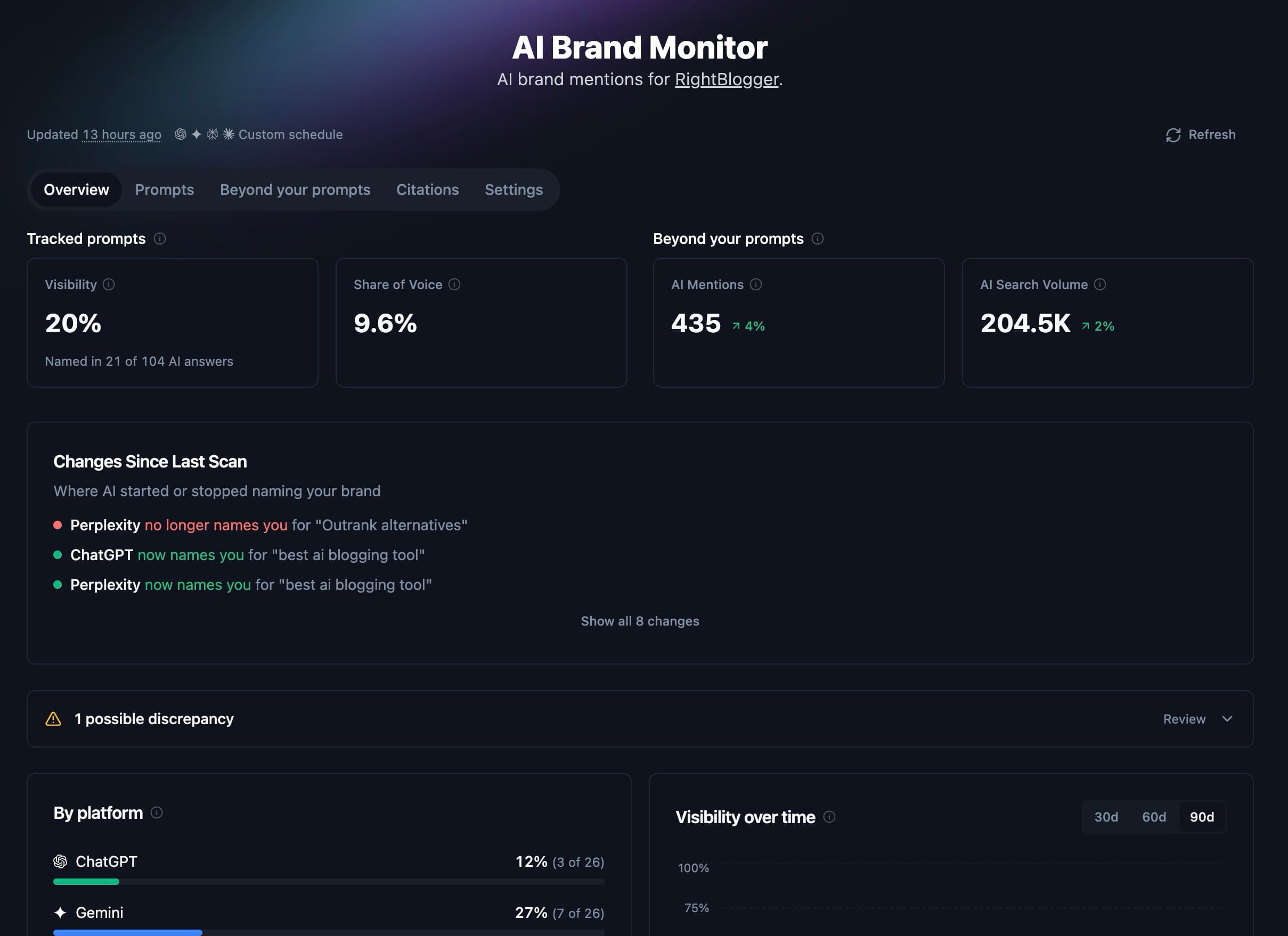
The AI Brand Monitor comes with a RightBlogger subscription rather than being sold as a standalone tracker. It asks your tracked prompts on ChatGPT, Gemini, Perplexity, and Claude, and reads Google AI Overviews from a live Google search in your project’s country. Here’s what it shows:
- A visibility score per platform, plus share of voice against the competitors you track
- Sentiment and position for each answer that names your brand
- The pages and domains AI cites, with 30, 60, and 90-day trend lines
- Which prompts gained or lost a mention since the last scan
- Answers that contradict your own site, quoted next to the passage they get wrong
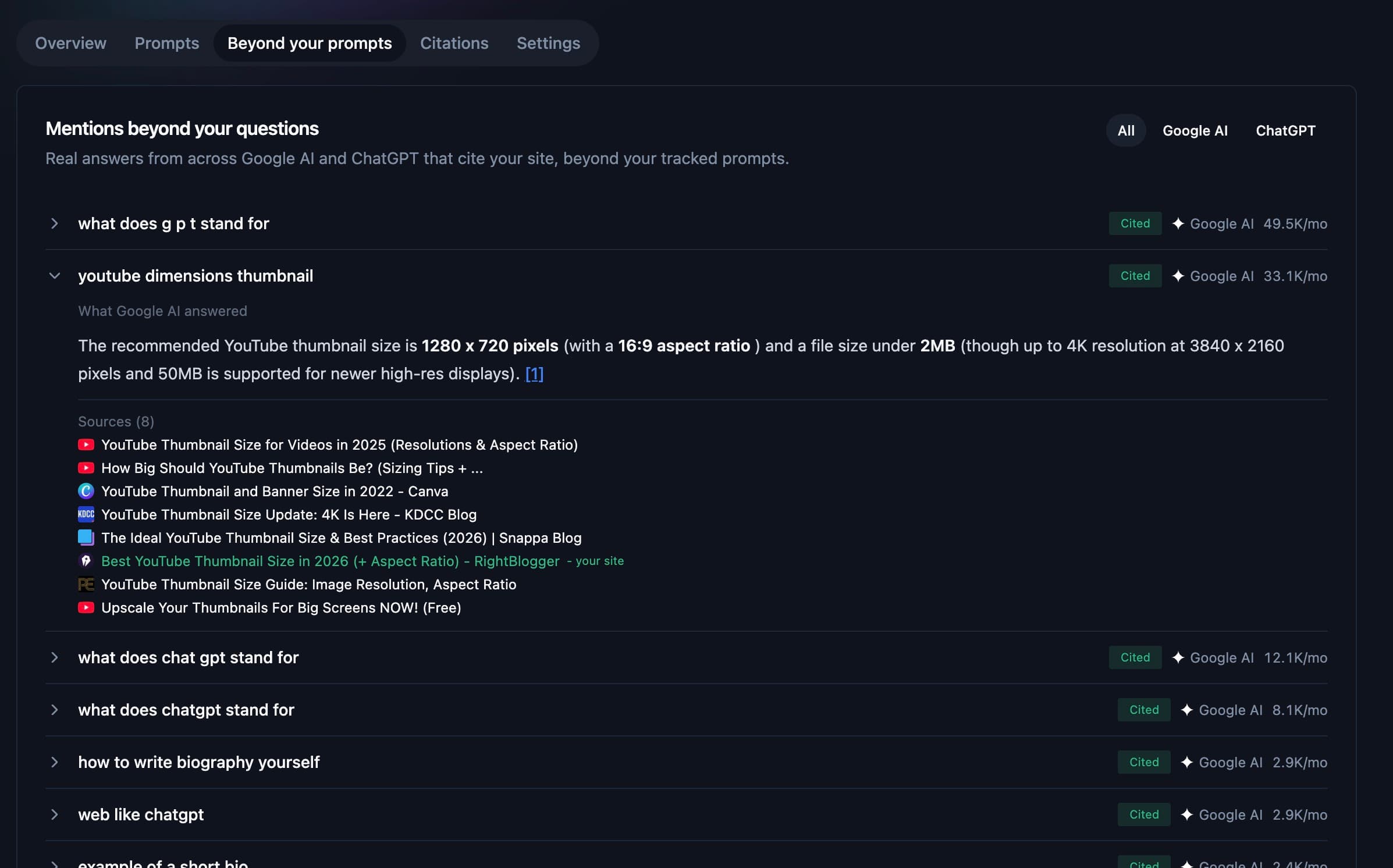
It also connects to the rest of RightBlogger. When a prompt stops naming you, Fix with agent can queue a Site Agent task to answer that question in your closest existing post.
Each site gets 25 checks a month, where one check is one prompt asked once on one platform. The starter setup of 8 prompts on 3 platforms, run monthly, uses 24 of them. Each platform can run daily, weekly, monthly, or not at all, within that allowance. It’s included on Solo (1 site, $49/month billed yearly or $59 monthly), Pro (3 sites), and Agency (10 sites, with white-label client reports), but not the free plan.
Skip it if you need to track many prompts daily, or coverage of Copilot, AI Mode, or Grok. 25 checks a month is a monitor, not a full tracker, and a dedicated tool like AIclicks or LLMrefs fits that job better.
Free LLM SEO Tools to Try First
Before paying for anything, check the free data you already have. None of these replace a tracker, but together they’ll tell you whether AI visibility is worth paying to measure.
- Google Search Console’s generative AI report shows impressions (not clicks) for your pages in AI Overviews and AI Mode.
- Bing Webmaster Tools’ AI Performance report shows which of your pages Copilot and Bing’s AI answers cite.
- Ahrefs AI Visibility Checker checks a brand name across ChatGPT, Gemini, Perplexity, Copilot, AI Overviews, and AI Mode, with no signup, and previews the top results.
- RightBlogger’s free AI Visibility Checker asks ChatGPT and Perplexity three questions your readers would ask and shows whether your site is named or cited, with no signup.
- Profound’s free trial runs 50 preset prompts daily for 7 days, which is enough to see where you stand in your category.
For query-level digging in Search Console, here is how to find AI Overview keywords in GSC.
How to Actually Do LLM SEO (Step-by-Step)
Knowing which tools exist is one thing. Knowing what to do with them is another. Here is a simple workflow you can follow whether you use a paid tool or start with manual checks.

Step 1: Check Your Current AI Visibility
Open ChatGPT, Perplexity, or Google AI Overviews and search for your main topics. Are you being mentioned? Are competitors showing up instead? For a structured version of that check, run the 10-minute audit in our guide to getting cited by ChatGPT; it scores three prompts and tells you which fix to start with. Then add the free reports above for a baseline before you pay for anything.
Step 2: Identify Your Content Gaps
Look at the prompts where competitors appear and you do not. These are your gaps. Pay attention to which sources AI cites in its answers, because that tells you what format and depth it trusts, and which third-party pages you’d need to be on.
Step 3: Fix Your Content Structure
AI models pull from content that answers questions directly. That means clear headings, short paragraphs, direct answers in the first sentence of each section, and FAQ sections that match real queries. If you use structured data, keep it matching the visible text on the page; Google says AI Overviews and AI Mode need no special schema markup. An Answer Engine Optimizer can help speed this up.
Step 4: Publish and Distribute
Publish your optimized content and repurpose it across platforms. The more places your content appears with consistent messaging, the more likely AI models are to recognize and cite your brand. Tools like RightBlogger’s autoblogging planner can automate the publishing side so you can focus on quality.
Step 5: Track and Iterate
Check back in your LLM SEO tool after a few weeks. Are your mentions increasing? Are new prompts triggering your brand? Use that data to decide which content to update next. This is not a one-time fix. It is an ongoing loop. RightBlogger’s Site Agent can handle parts of it for you, refreshing low-CTR meta descriptions and adding internal links across your published posts on a recurring schedule.
Which One Is Actually Worth It?
If you follow the workflow above, you need a tool that supports every step: visibility checks, prompt tracking, competitor gaps, and progress over time. For most creators, AIclicks is the paid tool I would buy first.
It solves the biggest problem with LLM SEO tools: vague reporting. Instead of a soft AI visibility score, you get concrete data on brand mentions, competitor gaps, sentiment, and the sources AI cites, checked daily.
LLMrefs is the better pick for agencies and multi-site reporting. If $59 is too much to start, Otterly.AI at $29/month is the cheapest way to get daily tracking, and Peec AI is worth the step up if citation sources matter most to you.
Frequently Asked Questions About LLM SEO Tools
What Is the Best Free LLM SEO Tool?
For ongoing data, Google Search Console’s generative AI report and Bing’s AI Performance report are free and come from the search engines themselves. For a quick check of what AI says about your brand, Ahrefs’ free AI Visibility Checker and RightBlogger’s free AI Visibility Checker both work without signing up. None of them track your own prompts on a schedule, which is what the paid tools add.
Is Semrush Enough for LLM SEO?
It can be if you already use it. As of November 2026, the AI Visibility Toolkit costs $99/month per domain for 25 prompts across ChatGPT, Google AI, Gemini, and Perplexity, and Semrush’s combined SEO and AI search plans start at $199/month with 50 prompts. If LLM tracking is your main reason to subscribe, a focused tool like LLMrefs covers every major engine for $79/month.
Do I Need a Separate Tool If I Already Use Surfer?
Usually, yes. Surfer helps you improve the page itself, and its AI Tracker on the Standard plan checks 25 prompts weekly in ChatGPT only. Pro or the standalone AI Search Analytics plan covers ChatGPT, Gemini, Perplexity, AI Overviews, and AI Mode daily. Dedicated tools like AIclicks can also track engines Surfer skips, such as Claude and Grok.
What’s the Cheapest Tool Worth Trying First?
Otterly.AI is the cheapest dedicated tracker at $29/month (or $25/month billed yearly) for 15 prompts checked daily. For most solo creators, though, AIclicks is the better first paid pick at $59/month, because 30 prompts and your choice of engines give you a more useful picture. If you only need a few prompts and already pay for Ahrefs, its standalone prompt packs start at $50/month.
How Many Prompts Should I Track?
Start small and specific. A good first set covers the questions buyers ask before they choose: “best [your category],” “[your brand] vs [competitor],” “[your brand] alternatives,” and two or three problems your product solves. That’s usually 10 to 30 prompts, which fits the starter plans above. Add more once you know which ones move.
Final Thoughts
Most LLM SEO tools sell promise. The ones worth paying for sell clarity.
If you’re spending real money on LLM SEO tools, you want prompt data, competitor gaps, the sources AI trusts, and clear next steps. Quality still matters, with E-E-A-T and on-page SEO at the core, because AI answers lean on pages that already rank.
Right now, AIclicks is the one I’d trust first, and LLMrefs is the backup pick when scale matters more than simplicity.

Article by
RightBlogger Co-Founder Ryan Robinson teaches 500,000 monthly readers how to grow online businesses and shares practical SEO advice.



Automated SEO Blog Posts That Work
Try RightBlogger for free, we know you'll love it.





Leave a comment
You must be logged in to comment.
Loading comments...