AI for Content Agencies: 7 Steps to Scale (Safely) Using AI Tools
Build a human-reviewed AI workflow that protects quality, client trust, and original insights.

AI can help a content agency publish more without hiring at the same pace. But agencies carry risks that solo bloggers don’t: every client’s brand voice, their trust in you, and the search traffic they pay you to grow.
The search side is less scary than it used to be. In April 2022, Google’s John Mueller said AI-generated content was against the webmaster guidelines. Google changed course in February 2023, and its updated guidance makes clear that AI-assisted content is fine, as long as it’s helpful, original, and written for people rather than search engines.
Quality and reputation are still on you, though. This post walks through seven steps to scale content production with AI without putting either at risk, plus the tools agencies tend to stack.
Benefits of AI for Content Agencies
You already know what generative AI is. For an agency, these are the benefits that matter most:
Saving Time
Time is a precious commodity in the world of content creation. If you have AI supporting your content creation process in some way, you can free up more time to work on growing your agency without jeopardizing customer satisfaction.
For your team members, AI content creation can reduce their workload in areas such as outline generation, content distribution, and proofreading, enabling them to focus on the more creative side of their job.
Increased Efficiency
Content marketing is demanding! For a single article, a writer may have to:
- Study and analyze the SERPs
- Do a content gap analysis
- Create an SEO-driven outline
- Write, edit, and optimize the draft
These tasks eat hours, even the hundredth time you do them. Handing some of them to generative AI frees your team for the parts that need judgment.
Don’t take my word for it. Andy Crestodina, co-founder and CMO of Orbit Media Studios, told Databox: “Any promotional content is faster now. I’ve trained it (AI) to write in my voice. This is early days. It will get better, and we’ll all get better at using it. I’m expecting a 20% productivity boost which is HUGE.”
For me, one of the most useful AI features for agencies is automated content gap analysis. Tools like Frase, Surfer SEO, and MarketMuse compare your draft with the pages already ranking and surface missing topics far faster than a manual SERP review.
Better Collaboration
A typical content team includes several members with separate tasks and functions, e.g., editors, writers, head of content, etc.
Most AI tools allow several members of a team to access their platform and share a virtual workspace. This facilitates better collaboration among content team members, regardless of their location or time zone.
For example, with features such as shared editing, commenting, and version control, your head of content can quickly review the first draft and leave some recommendations for your writers to work on.
This allows team members to be more cohesive and collaborative while putting out the best content possible.
Data-driven Insights
AI tools are faster and can analyze vast amounts of data to uncover valuable insights about target audiences, discover content gaps, and build a data-driven outline.
This enables you to make your content more personalized and data-driven.
Writers Shouldn’t Be Paid Less Because of AI
With all the benefits of AI, its adoption might mean different things to different agencies, and we just want to chip in our point of view here:
While AI offers numerous benefits for content agencies, it’s essential to recognize the value human writers bring to the table.
Writers should not be paid less simply because AI technology is being used to assist in content creation. The true value of a writer lies not in the number of words they produce but in their experience, expertise, creativity, and ability to connect with audiences on a deeper level.
AI may aid in generating content, but it cannot replicate the unique insights, perspectives, and storytelling abilities that human writers bring to the table.
Therefore, agencies should continue to compensate writers fairly for their contributions, recognizing that their skills and talents are irreplaceable assets in the content creation process.
7 Steps to Scale Content Safely with AI
These are the seven steps we recommend, in the order an agency should tackle them.
1. Identify Your Content Needs
Don’t just jump on adopting AI without first assessing your content needs. That’s like throwing things at the wall and hoping something will stick.
AI generative tools may do virtually the same thing, but they have different core competencies.
Some are good at generating long-form content, while others are best at generating product descriptions. Some are built for marketers, while others are, well, generic.
If you don’t understand your needs and how AI can improve them, you end up investing in the wrong software.
To help you map out your needs, below are some things you should consider:
Content Type
What type of content does your agency specialize in creating?
Whether it’s blog posts, social media content, long-form articles, or product descriptions, knowing your niche will guide you in selecting AI tools tailored to your specific content needs.
You should also consider other secondary activities like video or audio transcription. That helps now that so many teams weave subject matter experts’ views into their content.
Video transcription is a good example. If your agency repurposes video into written content, look for tools that handle transcription natively, such as Descript, Otter.ai, or the transcription features built into many AI writing platforms.
The bottom line is: you should also consider any other activity that’s essential to content creation.
Content Optimization
If you run an SEO agency and need help with keyword research, SEO analysis, and content performance tracking, you may consider an AI tool with features for finding keywords and optimizing content for SEO.
Content Distribution
If your agency is responsible for content distribution for your clients, you need to identify any bottlenecks AI can help you eliminate.
For example, do you need to always summarize your articles when distributing them across social media platforms? If yes, your AI of choice should have a feature to summarize your content.
Easy Collaboration
Evaluate your team collaboration dynamics and explore AI tools that facilitate smooth communication and workflow management.
With features like real-time editing, task assignments, and performance tracking, AI tools can optimize collaboration among team members for efficient content creation.
By carefully assessing your content needs across these key areas, you can strategically integrate AI tools into your content agency workflow to scale your operations efficiently and safely.
2. Create an SOP for Your AI Workflow
The absence of a standard operating procedure (SOP) in content creation can result in friction, leading to workflow disruptions and subpar outcomes. You surely don’t want that.
But an SOP will allow you to:
- Set your tone of voice
- Put down a procedure for planning and organizing keywords, content ideas, and topics
- Grant your team members more autonomy without lowering standards
- Ensure every piece of content published is up to standard
- Collaborate better with other team members
The goal is to determine where you’ll need an AI assistant, what AI software you’ll need, what role it will play, and which team members will need what.
For example, while everyone on your team needs proofreading software, not everyone requires a keyword research tool.
With a defined framework in place, you can map AI to varied content needs and specific team members without misallocating resources or priorities.
3. Select the Right Tools
Once you’ve identified your content needs and completed your SOP, it’s time to look for tools that’ll help you streamline those processes.
Here are some important considerations you should keep in mind when choosing AI tools:
Type of Content
When selecting AI tools for your content agency, it’s essential to consider the type of content you primarily work with.
Different AI tools are designed to excel in specific areas such as email, blogging, ad creation, product descriptions, etc.
Case in point: keyword clustering tools built for content marketers (Surfer’s Topical Map, Frase’s Topic Clusters, or RightBlogger’s Keyword Cluster tool) can group related topics in seconds. For a keyword like “content writing for beginners,” a clustering tool might surface sub-topics like writing frameworks, beginner mistakes, and content structure guides.
My point is: understanding the nature of your content will guide you in choosing the tools that align best with your content goals.
Customization Options
Customization plays a significant role in the effectiveness of AI tools for content agencies. Look for tools that offer flexibility and adaptability to tailor them to your agency’s unique requirements.
The ability to customize AI tools ensures they can cater to your specific content creation and management processes, enhancing overall productivity and quality.
Integration Capabilities
You probably have several tools you already use and love.
If such is the case, you’ll ideally want to go for AI tools that fit into your existing systems and workflows and integrate smoothly with your current tools and platforms.
This is to ensure a smooth transition and a streamlined content production process.
Compatibility and interoperability are key to maximizing the benefits of AI tools within your content agency.
In some cases, however, you may be able to ditch some of your old software if the AI content creation tool of your choice offers the same features.
For example, some AI writing platforms now include keyword clustering and SEO scoring natively, which can reduce the need for a separate SEO subscription. Evaluate whether a bundled platform saves you money versus best-of-breed individual tools. There are trade-offs both ways.
Budget Considerations
While investing in AI tools can significantly enhance your content agency’s efficiency and output, it’s important to consider your budgetary constraints.
Evaluate the costs associated with AI tools, including initial setup fees, subscription charges, and potential additional expenses.
Most importantly, be sure that the benefits these tools offer align with your agency’s budget and long-term financial goals.
4. Be Selective About What You Automate
Automation is great, but it can also quickly go sideways. While individual bloggers can crank out AI-generated content and go scot-free, you should be cautious as an agency owner.
As a content agency, relying too heavily on AI for creative work could tarnish your reputation.
AI drafts can also echo what’s already ranking, stay vague, or state things that aren’t true, so every draft needs a human fact-check before it reaches a client.
This is why you need to find the right balance between automation and human touch, which is key to scaling your agency successfully while maintaining your content standard.
Here are our top recommendations for automating and maintaining quality in your AI-powered content strategy:
Develop a Hybrid Process and Know When to Keep the AI Out
When contemplating automation for content creation, it’s important to evaluate the level of complexity and creativity demanded by each task.
From my experience, AI often falls short in certain areas. It’s riskiest on health and finance topics, where Google says its systems give even more weight to strong E-E-A-T and a single error can hurt a reader.
Technical subjects also need nuanced input from someone who knows the field.
Assess the intricacies of the required content and determine the instances where human creativity is indispensable, balancing it with the appropriate level of AI involvement.
Personalize Client Interactions
Automating client interactions may seem efficient, but when it comes to building relationships and understanding client needs, a human touch can make all the difference.
It can also backfire!
When AI eventually makes a mistake or they find out you’ve been using AI to communicate with them, you may lose their trust forever.
Ensure Quality Control
Generative AI has no firsthand expertise of its own.
Generative AI operates by analyzing patterns in data to predict the probability of one word succeeding another and then assembling these predictions into a cohesive sentence.
They don’t truly “write” in the conventional sense, but guess what should come next in a sentence.
While AI automation can accelerate processes, maintaining quality is the foremost priority for content agencies.
To ensure quality control, certain tasks, like final content review and editing, should be left for humans to guarantee correctness and coherence.
5. Inject Information Gain into Your Content
If you’re into SEO, you’re probably aware of this: information gain is a big deal. It’s what helps your content stand out and really hit home with your audience.
If you aren’t familiar with it, information gain comes from a Google patent filed in 2018 (published in 2020 and granted in the US in 2022). It describes scoring a document by how much new information it adds beyond what the user has already seen.
Google hasn’t confirmed it uses the patent for ranking, but its own helpful content questions ask whether a page provides “original information, reporting, research, or analysis.” Either way, the lesson is the same: copycat content gives readers nothing new.
That’s the opposite of the old skyscraper technique, where brands with strong domain authority outranked each other by publishing a slightly better version of the top result.
Ways to add information gain to your article:
- A single search phrase can have multiple intents, so serve one that competitors skip. For instance, while many articles about AI content writing tools target marketers and sales teams, yours could target essayists and academics instead.
- Add steps that competing articles leave out. For example, when discussing social media marketing for small businesses, many articles focus on conventional tactics like consistent posting, engaging with followers, and targeted ads. A fresh section such as “Micro-Influencer Collaboration” will set your content apart.
- Include firsthand perspective. Many articles are written by people with no direct experience of the topic. If you or your client’s experts have relevant experience, working it into the content makes it more credible and useful.
- Change the content structure. It carries some risk, but shaking up the typical structure can pay off. For instance, if most articles on the SERP are listicles, consider writing a how-to guide mixed with a listicle.
- Use your company’s own data. Did your company run experiments that challenged or confirmed industry norms? Have you learned something from customer interactions or feedback? Working those findings into your content gives readers a perspective they can’t get anywhere else.
6. Monitor and Improve Performance
If you are new to any process, it will take some time before you perfect it, irrespective of the guide you read.
This is why constant monitoring and improvement are key to the success of your new process.
For your AI-backed content creation process to succeed, we recommend the following steps:
Set Content Performance Metrics
To initiate the process of monitoring and enhancing performance, establish metrics and closely monitor them. These metrics may include:
- Publishing velocity
- Engagement rates
- Click-through rates
- Time spent on a page
- Conversion rates
These metrics offer invaluable insights into the impact and effectiveness of your content, directing your improvement efforts effectively.
Feedback Integration
Feedback is a goldmine for improvement. Actively seek feedback from clients, readers, and team members to gather diverse perspectives on your content.
Integrate this feedback into your content refinement process to address areas for improvement and tailor your strategy to meet everybody’s expectations.
For that, you can use:
- HubSpot’s Customer Feedback Software
- Your internal Slack channel
- AskNicely
Prioritize Analytics
Use data to compare your current content performance to your performance prior to introducing AI into your workflow. Examine several measures to discover if you’re gaining or losing and what might be changed.
Tools to do that include:
- GA4
- Google Search Console
- Buffer
7. Ensure Transparency
Transparency is key when implementing AI-backed content creation in content agencies. It’s important to maintain openness and clarity in the processes involving AI to build trust with clients and ensure ethical standards are upheld.
So, transparency would mean:
Transparency in Data Collection
When using AI tools for content creation, it’s important to be transparent about the data being collected. Inform clients about the type of data that will be used, how it will be gathered, and for what purposes. By being transparent about your data collection practices, you can establish trust with your clients.
Explaining AI Algorithms and Processes
Transparency also extends to explaining the AI algorithms and processes used in content creation.
Provide clients with an overview of how the AI tools work, the methodologies behind them, and the potential outcomes. This not only educates clients but also fosters confidence in the AI-driven content production process.
Disclosure of AI Assistance
Clearly disclose when AI tools are being used to generate content. Whether it’s in the form of automated content generation or data analysis, informing clients about AI assistance ensures transparency in the content creation process.
This clarity helps clients understand the role of AI in producing the final deliverables.
AI for Content Agencies: Our Top Recommendations
Most agencies don’t rely on a single AI tool. The best setups combine an AI writing assistant with a content optimization platform and a workflow layer. Here are our top picks across categories:
Content Generation Tools
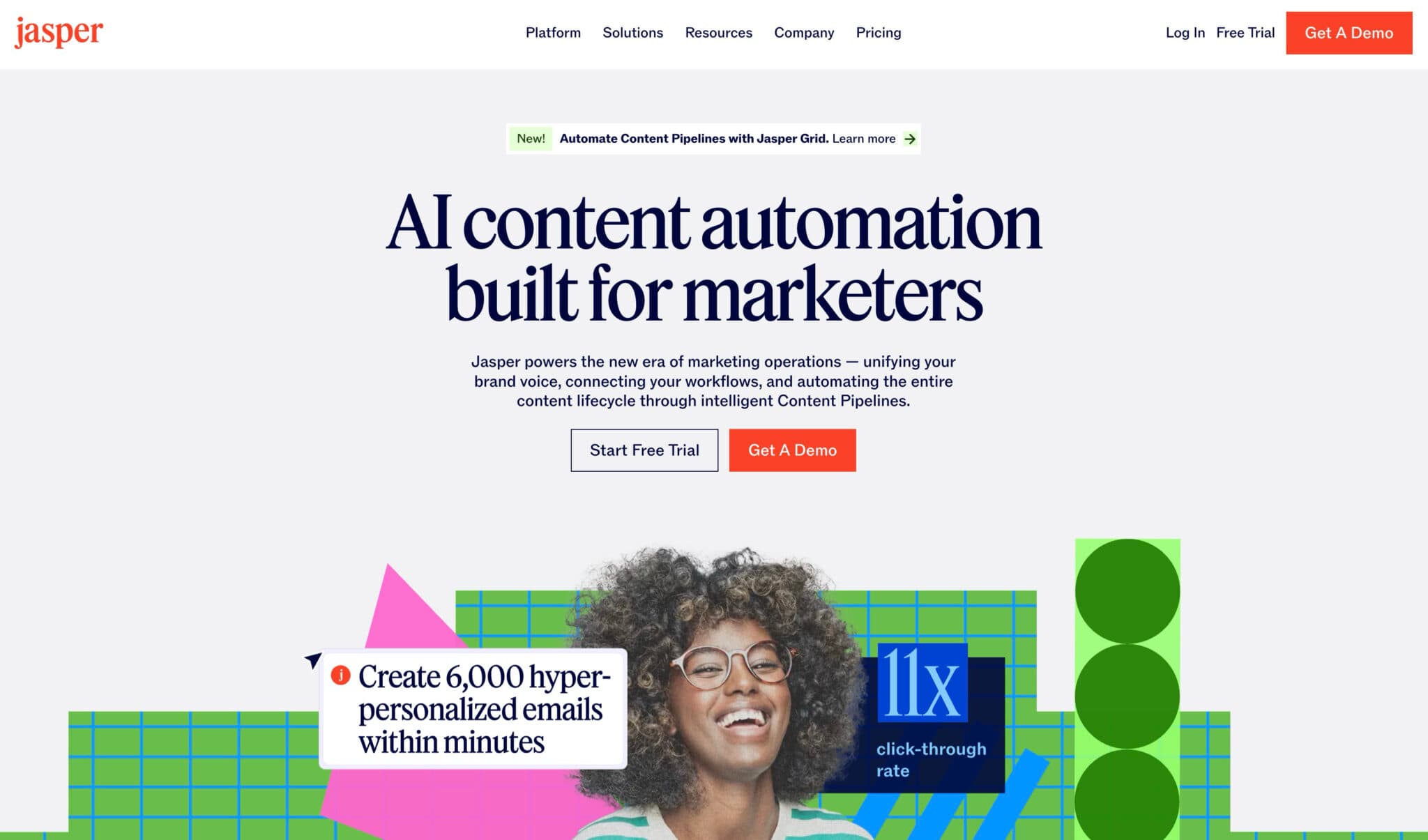
Jasper is built for marketing teams and agencies. Its Brand Voice feature learns each client’s tone, which helps when you manage multiple accounts, but Pro includes only 2 Brand Voices. Pro costs $59/mo per seat billed annually ($69 month-to-month), and the custom-priced Business plan adds unlimited voices.
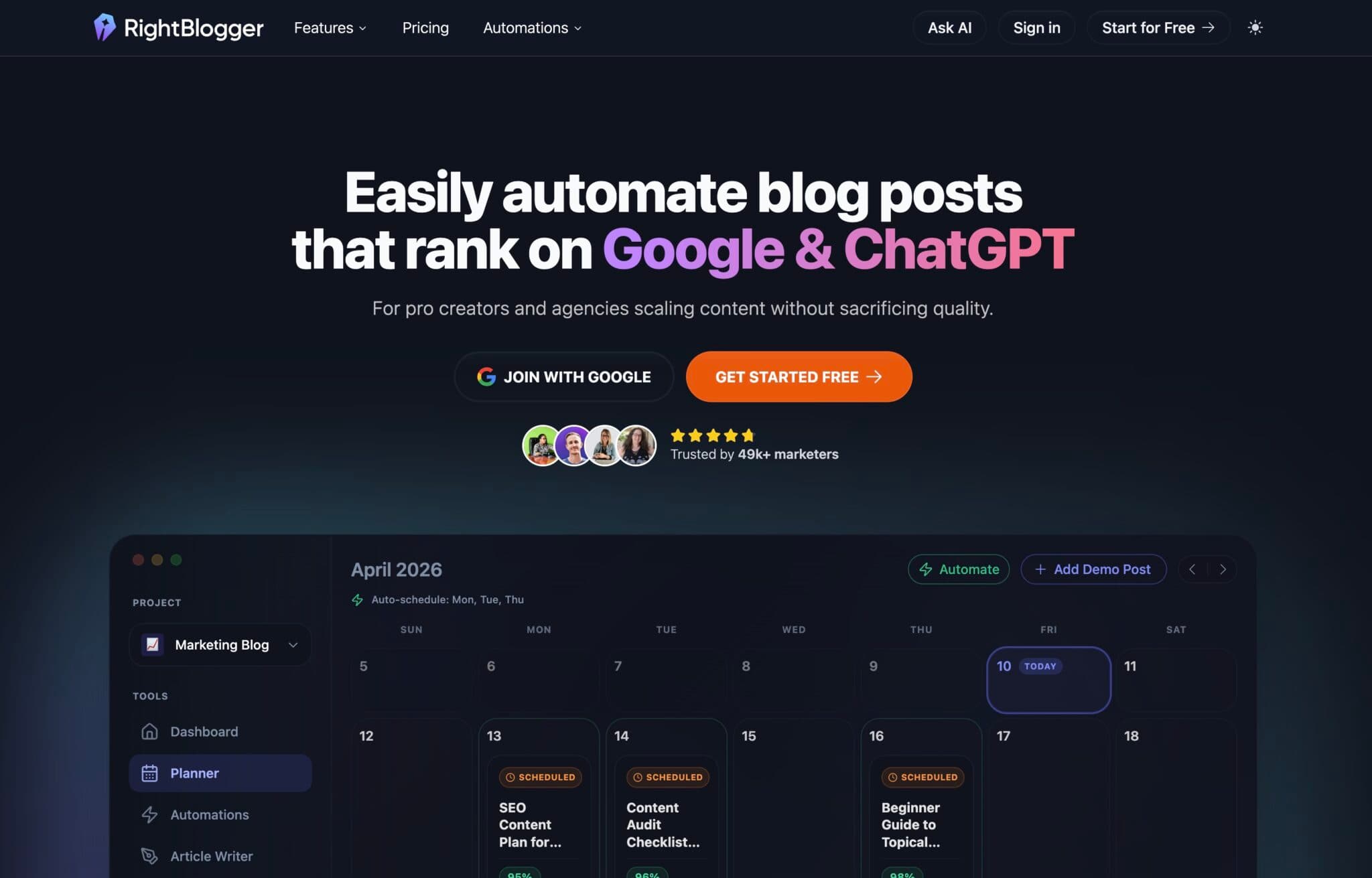
RightBlogger is built for bloggers and content teams, with autoblogging automations, a visual content planner, and publishing to 12 CMS platforms, including WordPress, Shopify, and Webflow. MyTone saves each client’s voice (up to 50 styles on Agency). There’s a free plan, and paid plans start at $49/mo billed annually. Skip it if you only need to grade drafts that humans write.
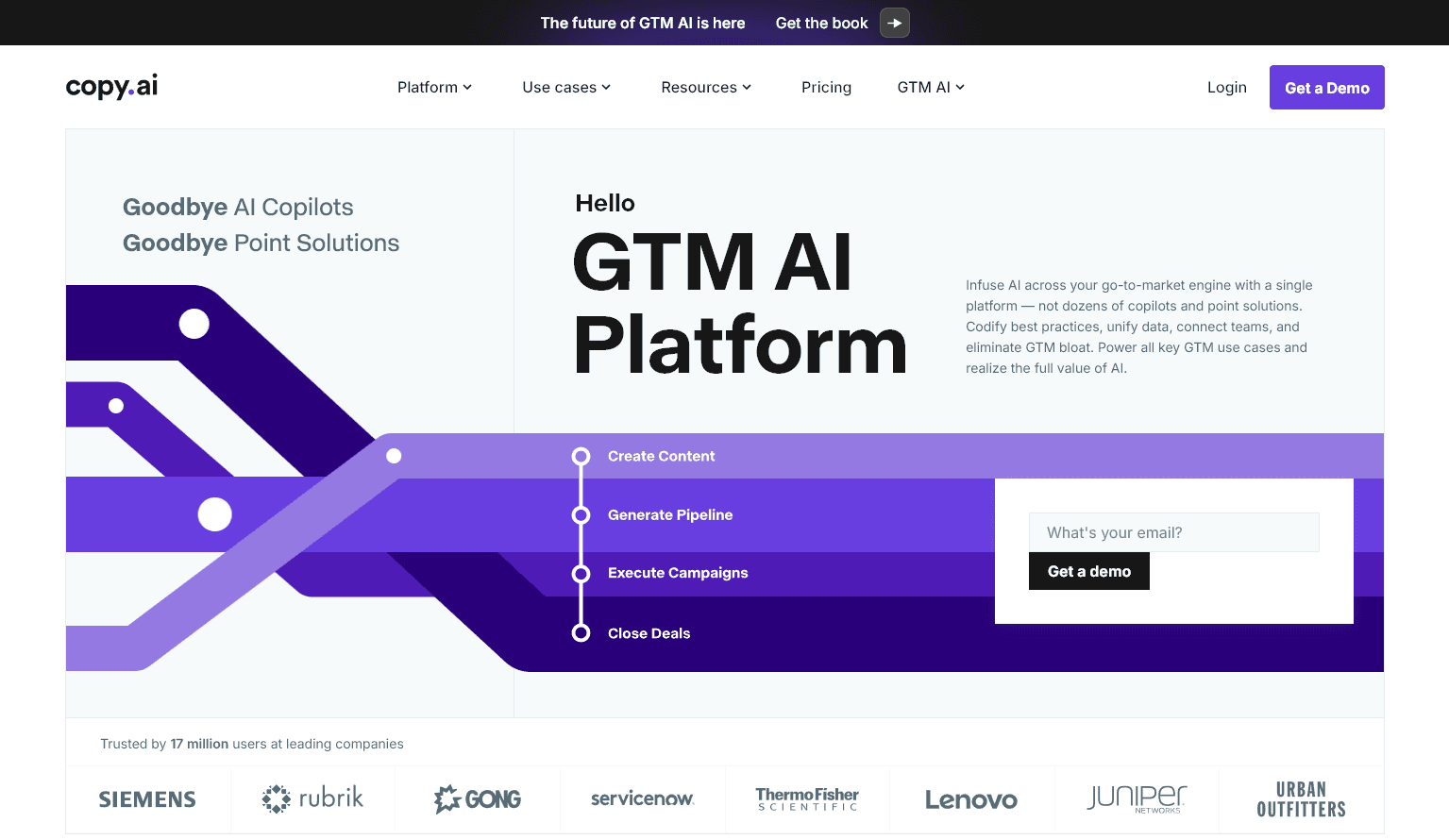
Copy.ai has pivoted from a pure writing tool to a go-to-market workflow automation platform. Best for agencies that need to automate repetitive marketing tasks beyond just writing, including multi-step sales and content workflows. The Chat plan costs $29/mo ($24/mo billed annually) for up to 5 seats, and workflow automation starts with the Growth plan at $1,000/mo billed annually.
SEO + Content Optimization Tools

Surfer SEO (now at surfer.ai) is a strong all-rounder for optimizing content at scale. Its Content Score updates in real time as you write, and its Topical Map handles cluster planning. Billed annually, plans run from Discovery at $49/mo to Standard ($99), Pro ($182), and Peace of Mind ($299), with higher tiers adding capacity and AI visibility tracking.
Frase is a good value for automated content briefs. It researches the top-ranking pages and turns them into a structured brief, and it adds GEO (Generative Engine Optimization) scoring and AI Visibility tracking for AI search. Starter costs $39/mo billed annually ($49 monthly), and the Scale plan ($239/mo billed annually) is aimed at agencies running up to 10 sites.
Clearscope has the simplest content grading interface. Writers immediately understand its A++ to F scoring system without training. All plans include unlimited users, which removes per-seat cost anxiety for agencies with large freelancer pools. Starting at $129/mo.
General-Purpose AI Assistants

ChatGPT is the most versatile option with the largest ecosystem. Every writer already knows it, making onboarding frictionless. The Business plan (formerly Team) starts at 2 users and gives the agency a shared workspace for brainstorming, drafts, and research.
Claude is a strong pick for writing quality, especially long-form content, and its drafts tend to sound natural on thought leadership, guides, and nuanced topics. Team costs $25 per seat billed monthly, or $20 billed annually.
Pro tip: Most successful agencies stack tools. For example, Claude or ChatGPT for first drafts, Surfer SEO or Frase for optimization, and Jasper or RightBlogger for scaled production with brand voice consistency.
How to Scale Content Safely with AI
Scaling safely with AI is mostly a process change. To recap, the seven steps are:
- Identifying your content needs
- Creating an SOP
- Selecting the right tools
- Being selective about what you automate
- Injecting information gain into your content
- Monitoring and improving your content performance
- Ensuring transparency
Start with one client and one workflow, compare the results against your pre-AI numbers, and expand from there.

Article by
Ali Faagba is a content strategist and B2B SaaS writer who covers AI, marketing automation, and sales for companies like Close and Userpilot.



Automated SEO Blog Posts That Work
Try RightBlogger for free, we know you'll love it.





Leave a comment
You must be logged in to comment.
Loading comments...