Will AI Replace Bloggers? The Future of Content Creation
Human expertise wins, while top-five rankings drive most AI search citations.

AI has changed blogging fast.
A few years ago, writing a full blog post with AI felt experimental. Now tools powered by models like GPT-5.6 can draft articles and even suggest SEO improvements in minutes. AI Overviews now appear on roughly a third of informational searches, and AI assistants like ChatGPT, Claude, and Perplexity are citing blog posts as primary sources.
So it’s fair to ask: will AI replace bloggers?
If you’ve felt uneasy watching AI pump out content at scale, you’re not alone. But the real story isn’t about replacement. It’s about how AI fits into the blogging process, what it still cannot do on its own, and how the rise of AI search is changing the game for bloggers in 2026.
In this post, we’ll break down what AI is actually good at, where it falls short, how AI search and AI Overviews change the playing field, and whether human bloggers truly have anything to worry about.
Key takeaways
- AI tools can help bloggers with idea generation, content optimization, and routine tasks.
- AI cannot replicate the expertise or personal stories that human bloggers bring.
- Google’s scaled content abuse spam policy actively demotes mass-produced AI content with no human value-add.
- AI Overviews and AI search assistants overwhelmingly cite from the top organic results, so traditional SEO still matters (a lot).
- The most effective approach combines AI efficiency with a blogger’s unique voice and real experience.
Why AI Is Suddenly Everywhere
AI isn’t just a tech trend anymore. It’s baked into tools most of us use every day.
From voice assistants to recommendation engines, AI quietly shapes how we search and create. And in the content world, tools like ChatGPT have made it possible for anyone to generate blog posts, social captions, outlines, and even full marketing campaigns in minutes.
That shift feels massive.
For bloggers, it raises real questions. If AI can write articles this quickly, what happens to the people who used to spend hours drafting them?
The key thing to understand is this: AI is powerful, but it is not magical. It works by predicting patterns based on data it has already seen. That makes it fast and helpful, but it also creates real limits.
To understand whether bloggers should worry, we need to look at what AI can truly do and where it still falls short.
What AI Language Models Can Actually Do
Modern AI models like GPT-5.6 and Gemini 3.1 Pro are trained on massive amounts of text. That training allows them to recognize patterns in language and generate responses that sound clear and relevant.
They’re very good at producing content quickly.
For bloggers, this can be useful. We’ve covered many of these use cases in our guide to AI in content creation.
Here are some of the most common strengths of AI tools:
- Drafting blog posts and long-form articles
- Creating product descriptions
- Writing social media captions
- Generating FAQs and summaries
- Producing outlines and key takeaways
AI can also clean up grammar and restructure messy drafts. If you give it clear instructions and context, it can produce a solid first version in minutes.
But there’s an important limit.
AI does not truly understand your lived experience or your audience. It predicts what words should come next based on patterns in its training data. That means it can sound confident and polished, but it cannot create genuine firsthand insight.
It does not have opinions. It does not test ideas in the real world. It does not build something, fail at it, and learn from the process.
That difference matters more than ever in blogging.
The Real Threat in 2026 Is AI Search, Not AI Writers
If you’re worried about AI replacing bloggers, the more interesting question to ask is: what happens to blog traffic when readers stop clicking through to blog posts at all?
That’s the real shift happening right now. AI Overviews appear on roughly 28-30% of informational Google searches and growing. ChatGPT search, Perplexity, Claude, and Gemini all answer questions inline using content from across the web. A reader who would have clicked through to your “best ___” post in 2022 might now get a summarized answer at the top of their search, with three small citation chips beneath it.
This sounds scary at first. It’s not as scary as it looks, for two reasons.
First, AI Overviews and AI search assistants overwhelmingly cite from the top organic results. Multiple independent studies (and our own analysis across a dozen RightBlogger user blogs) show that roughly 80% of AI citations come from pages already ranking in the top 5 organically. That means traditional SEO didn’t get less important. It got more important. If you rank well, you get cited. If you don’t rank, you also don’t get cited.
Second, AI summaries reduce surface-level “what does X mean” traffic, but they tend to drive higher-intent traffic when readers do click. Someone who reads an AI summary and still clicks your link usually has a more specific need. CTR drops a bit, but conversion rate often goes up.
If you want to dig into the practical side of this, our guides on GEO vs SEO and finding AI Overview keywords in Google Search Console walk through the specific moves that improve your odds of being the cited source.
Why Originality and Lived Experience Matter More, Not Less
Originality is a core ingredient of successful blogging. Readers come to blogs expecting fresh ideas and personal experiences. AI can generate content quickly and efficiently, but it cannot replicate the unique voice and perspective that human bloggers bring. This is part of why we built the additional instructions field into many of our tools at RightBlogger: it lets you inject your real expertise into the draft before AI ever generates it.

Bloggers often have years of experience and expertise in their niche, which lets them offer in-depth insights and analysis AI simply can’t match. Human bloggers can draw from their own work, conduct original research, test products they actually bought, and offer expert advice that resonates with their audience.
There’s a part most people miss: AI defaults to consensus. It’s trained on what’s already been written across the web, so its output gravitates toward the average take on any topic. That’s exactly the wrong content to publish in 2026, because the average take is what AI summaries themselves already give readers for free. The only writing that earns clicks now is writing AI couldn’t have produced: a specific opinion, a real workflow you’ve used, a failure you learned from, a number you measured yourself.
This is also where Google’s E-E-A-T framework lands hardest. The first E (Experience) is the one AI cannot fake. A reviewer who actually used the product for six months will always outrank a reviewer who paraphrased the spec sheet, no matter how polished the prose is.
The Role of AI in Blogging
So if AI can’t replace human bloggers entirely, what role does it play in content creation? A few ways bloggers can use AI to amplify their own work:
- Idea generation. AI tools can help bloggers brainstorm topic ideas and identify trending keywords to optimize content for search engines.
- Content optimization. AI can analyze blog posts and provide suggestions for improving readability and SEO.
- Personalization. AI can help bloggers deliver personalized content recommendations based on user behavior and preferences.
- Automation. AI-powered tools can automate certain parts of the blogging process, like scheduling social media posts or generating meta descriptions.
By using AI as a complement to their own skills and expertise, bloggers can streamline their workflow and focus on creating high-quality content that resonates with readers. Read our post that goes deeper on how bloggers can use AI in their workflows.
One area where this is especially visible is autoblogging. When done poorly, autoblogging means publishing large volumes of untouched AI content. When done correctly, it’s about building smart systems that help you research, draft, optimize, and refine posts faster while keeping your voice in control. If you’re curious how modern platforms approach this, we’ve broken down the best autoblogging tools and what separates quality workflows from spammy shortcuts.
The Future of Blogging
As AI continues to evolve, it’ll play an increasingly important role in content creation. But it’s unlikely AI will replace human bloggers entirely.
The future of blogging looks like a collaboration between humans and machines, with AI tools amplifying the creativity and expertise of human writers. Google’s scaled content abuse spam policy actively demotes sites publishing mass AI-generated content with no human value-add, while their core algorithm updates continue to reward sites with real expertise and original perspective. The message from Google is consistent: it’s not “no AI.” It’s “no AI without you in it.”

To stay relevant, bloggers should learn to use AI well rather than avoid it. That means staying current with the latest AI tools and experimenting with new formats.
At the same time, double down on what makes you unique: your personal experiences and voice. By combining the efficiency of AI with the creativity and authenticity of human writers, bloggers can create content that genuinely stands out in a crowded online space.
Frequently Asked Questions
Will AI take over blogging and make writers irrelevant?
No. AI handles routine tasks well, but it cannot match the originality or expertise of real human writers. Human input remains central to top-quality blog content, and Google’s algorithm updates continue to reward sites with that human signal.
Can AI-generated content get penalized by Google?
Google’s scaled content abuse spam policy demotes sites publishing large volumes of AI content with little personal value or originality. AI tools work best when humans add unique insights and direct expertise.
What is the best way to use AI as a blogger?
Use AI for generating ideas, optimizing posts, and automating repetitive tasks. Always add your personal touch and real stories to create standout content.
How does AI search (AI Overviews, ChatGPT search) affect bloggers?
AI summaries reduce some surface-level click-through traffic. But AI assistants overwhelmingly cite pages already ranking in the top 5 organic results, so traditional SEO is still the foundation. Bloggers who already rank well tend to get cited. See our guide on GEO vs SEO for the specific moves.
How do I know if readers care about my personal input?
Unique stories and personal opinions build trust and engagement. Readers often return for authentic voices, not generic information they could get from a 30-second AI summary.
Should new bloggers use AI tools?
Yes. AI can help with research, basic drafts, and SEO tips. Success comes from adding your own experiences and refining AI-generated text before publishing.
Conclusion
AI is changing blogging. That much is clear.
But change does not mean replacement.
AI can help you move faster. It can generate outlines, draft posts, suggest improvements, and handle repetitive tasks. Used well, it saves time and reduces friction in your workflow. That’s powerful.
What it cannot do is replace your lived experience, your opinions, your stories, or the trust you build with readers over time. It also cannot rank in Google or get cited by ChatGPT without the underlying SEO foundation that human-led content tends to do better.
The bloggers who will win in the years ahead aren’t the ones who avoid AI. They’re the ones who use it wisely. They treat AI as a tool, not a substitute.
If you want to go deeper on how to use AI responsibly and effectively in your content strategy, check out our free AI Foundations course, our guide to how bloggers can use AI in their workflows, and the real ways to make money with AI.
Blogging is not dying. It’s evolving. And the creators who combine smart systems with real human perspective will continue to stand out.
Complete Blog Automation in Minutes
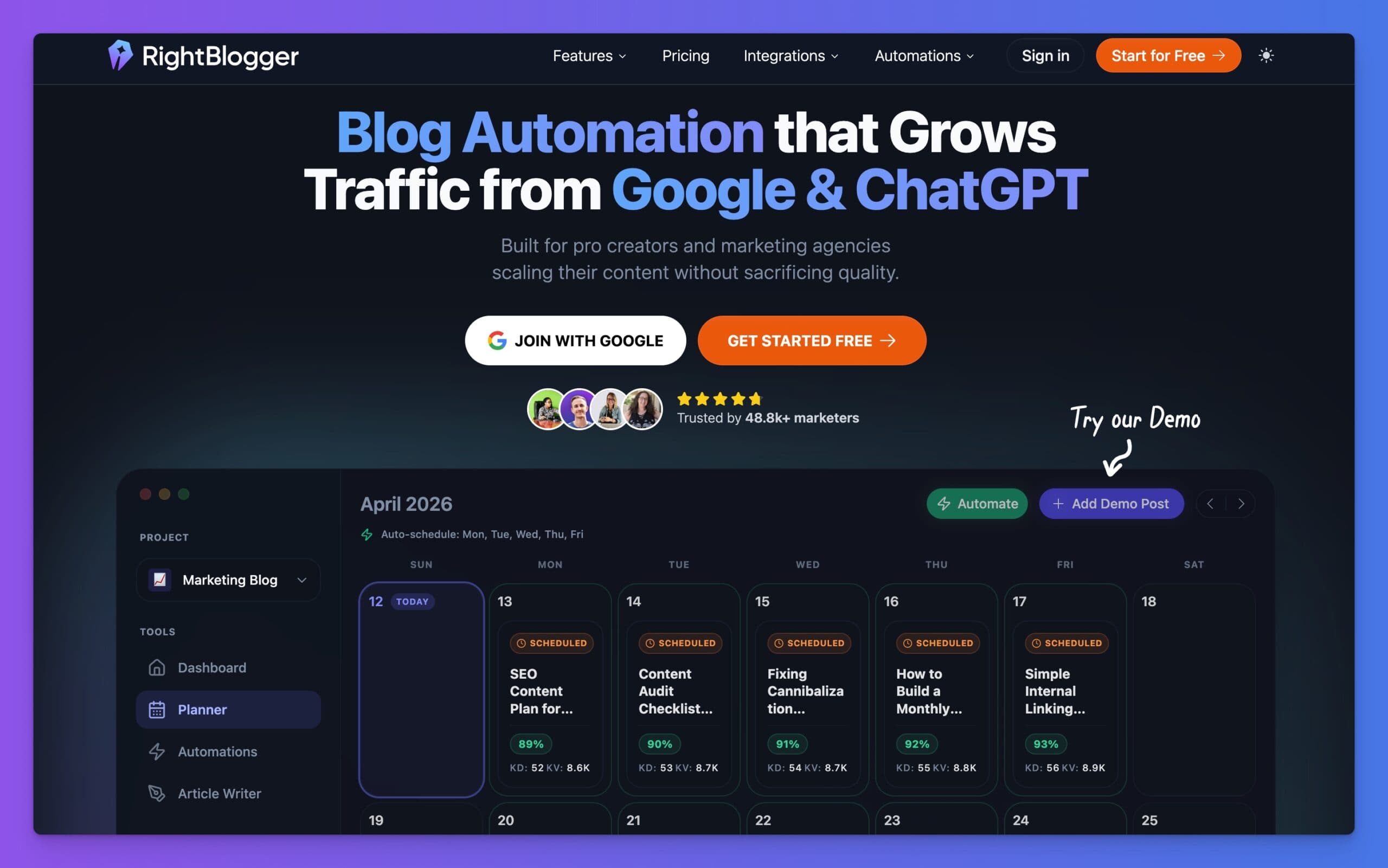
RightBlogger is an AI blog automation tool that helps you research, write, publish, promote, and maintain your blog. Join 50,000+ bloggers, creators, and marketing teams using it to grow traffic from Google and ChatGPT, with 80+ standalone tools, online courses, and a private community included on every plan.

Article by
RightBlogger Co-Founder, Andy Feliciotti builds websites and shares travel photography on YouTube and his travel blog.

Automated SEO Blog Posts That Work
Try RightBlogger for free, we know you'll love it.





Leave a comment
You must be logged in to comment.
Loading comments...