What Does GPT Stand For? (Simple Explanation + How It Works)
Each term explains how the model turns vast text training into context-aware responses.

GPT stands for “Generative Pre-trained Transformer”, the AI technology behind ChatGPT and many other AI tools. It’s a type of artificial intelligence model that reads input and writes human-like text in response. OpenAI popularized GPT with the launch of ChatGPT, which now has hundreds of millions of users worldwide.
What you need to know:
- GPT stands for Generative Pre-trained Transformer, an AI model that understands and produces human language.
- OpenAI’s GPT powers tools like ChatGPT, used for writing and answering questions in conversational form.
- Businesses use GPT for content creation, customer service automation, and translation.
- Each new version of GPT (currently the GPT-5 series) raises the quality of reasoning and expands what AI can do for creators and businesses.
- GPT powers tools like RightBlogger’s Article Writer that help bloggers and businesses create content faster.
What Does GPT Stand For?
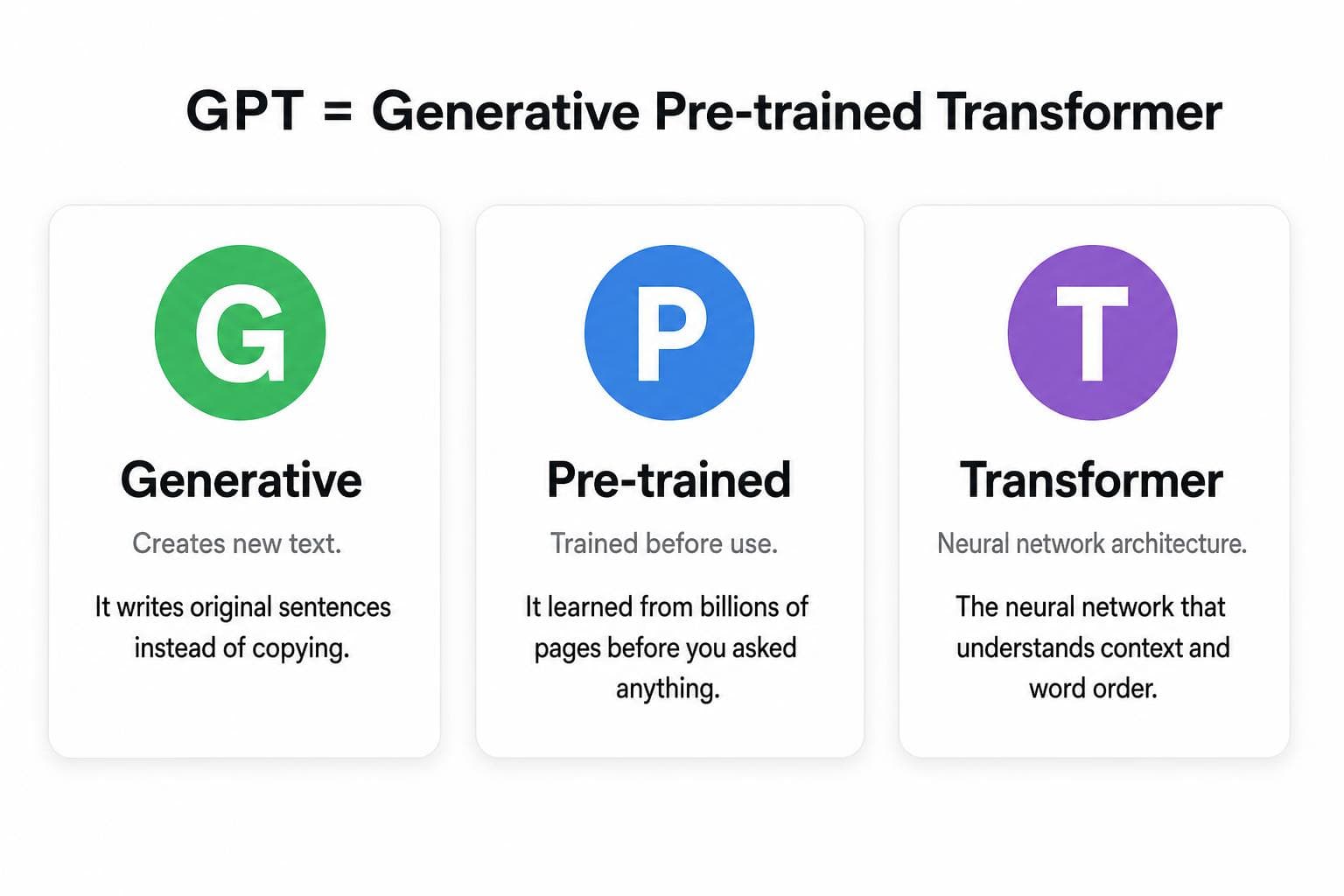
GPT stands for Generative Pre-trained Transformer. It’s a type of AI model trained on huge amounts of text so it can read input and produce human-like writing. The “GPT” you see in ChatGPT is the underlying model. Three words that describe exactly how it works.

In this post, you’ll learn what GPT means and how it works, plus where it’s making the biggest impact today for creators and businesses.
What is GPT and How Does It Work?
GPT stands for Generative Pre-trained Transformer. It is a class of AI models that learn patterns in language and then use those patterns to write text that reads like it was written by a person. OpenAI popularized this approach with ChatGPT, which millions now use for questions and writing help.
At a high level, GPT does two things very well. It predicts the next word in a sentence based on the words before it, and it uses that skill to build full readable answers. The result is a system that can hold a conversation and compose text on nearly any topic you bring up.
Let’s break down the full GPT acronym:
Generative means these models can create original text. They generate coherent, relevant content based on the given input.
Pre-trained indicates that the models are trained on vast diverse datasets before you ever use them. That training is where the AI picks up its understanding of language and the topics it can discuss.
Transformer is the neural network architecture behind models like OpenAI’s GPT-5.6 and Google Gemini. It effectively processes sequential data and uses attention mechanisms to generate high-quality text.
This is why writing a great prompt in ChatGPT is so important. Your prompt guides the transformer to select specific words and give you the results you want. Of course, as we progress through different versions like GPT-3 and today’s GPT-5.6 the capabilities of these large language models (LLM) increase.
What Does ChatGPT Stand For?
ChatGPT stands for “Chat Generative Pre-trained Transformer.” The “Chat” part refers to the conversational interface that OpenAI built on top of their GPT model. While GPT is the AI engine that processes and generates text, ChatGPT is the product that lets you interact with it through a back-and-forth conversation.
Think of GPT as the brain and ChatGPT as the messenger. GPT also powers other tools beyond chat (AI content creation platforms, code assistants, translation services, and more), but ChatGPT is the most well-known application of the technology.
GPT Versions: A Brief Timeline
GPT has evolved through several major versions, each a significant step forward:
- GPT-1 (2018): The original model that proved the concept of generative pre-training worked.
- GPT-2 (2019): A major quality improvement. OpenAI initially withheld it due to concerns about misuse.
- GPT-3 (2020): A massive leap to 175 billion parameters, powering the first wave of AI writing tools.
- GPT-3.5 (2022): The model behind the original ChatGPT launch that brought AI into the mainstream.
- GPT-4 (2023): Added multimodal capabilities (text + images) with significantly better reasoning.
- GPT-4o (2024): A faster, more efficient version of GPT-4 optimized for speed.
- GPT-5 through GPT-5.6 (2025-2026): Major improvements in reasoning and tool use, plus better token efficiency. The current family is GPT-5.6, released July 2026, which ships in Sol, Terra, and Luna variants.
Each version builds on the same Transformer architecture with more training data and improved safety measures. For a deeper look at how to get the most from these models, check out our guide to prompt engineering.
The Impact of GPT
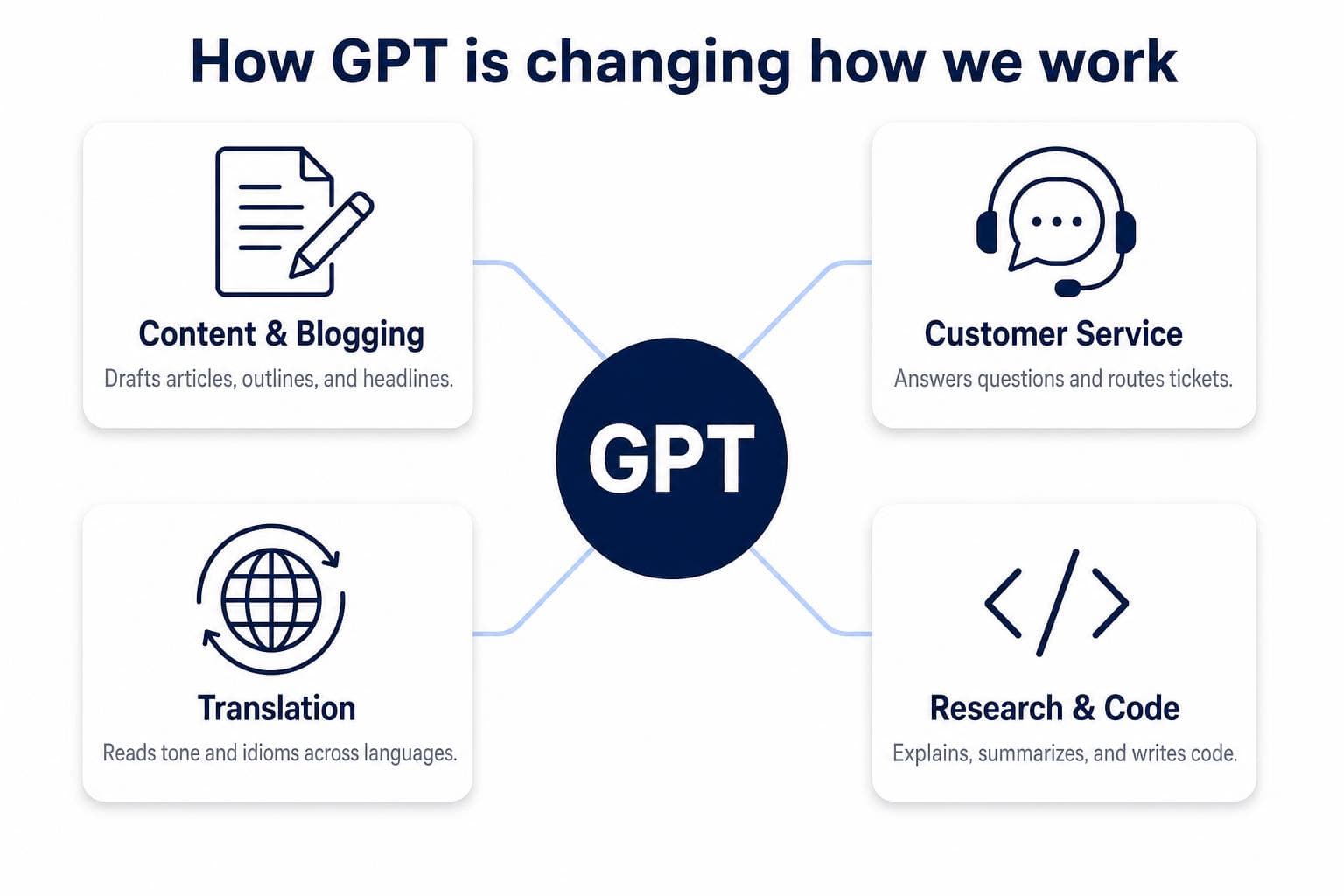
GPT-powered AI is reshaping how we work online. The biggest impact areas right now: content creation and blogging, customer service automation, language translation, plus research and coding support. Large language models excel at producing clear humanlike text, which changes how businesses communicate and how people interact with technology day to day.
GPT in Content Creation
Creators use GPT to spark ideas and tailor drafts to their audience. It handles outlines and first drafts (plus tone shifts on rewrites), which helps you publish more without losing quality. (Need prompts? See our best ChatGPT prompts for writing.) Many of RightBlogger’s AI tools for bloggers run on GPT and slot into this workflow.

GPT in Customer Service Automation
Many teams now use GPT for frontline support. It answers common questions instantly and drafts helpful replies for the tougher issues that get routed to humans. GPT-powered chatbots understand intent and context, which speeds resolution and lowers support costs at the same time.
GPT in Language Translation

GPT has improved translation quality in a big way. It produces context-aware translations that read naturally in the target language. With stronger language understanding, it handles idioms and domain-specific terminology better, which makes cross-language communication smoother.
GPT’s Future Development
GPT models keep improving, especially with OpenAI releasing models like GPT-5.6. Each new version boosts language quality and reasoning. As research advances, you can expect more accurate answers and safer outputs.
Big tech is investing heavily. Companies like Microsoft and Google (plus chipmakers like Nvidia) are pouring resources into AI research and infrastructure. That momentum will push GPT-style systems forward over the next few years.
GPT vs LLM vs AI
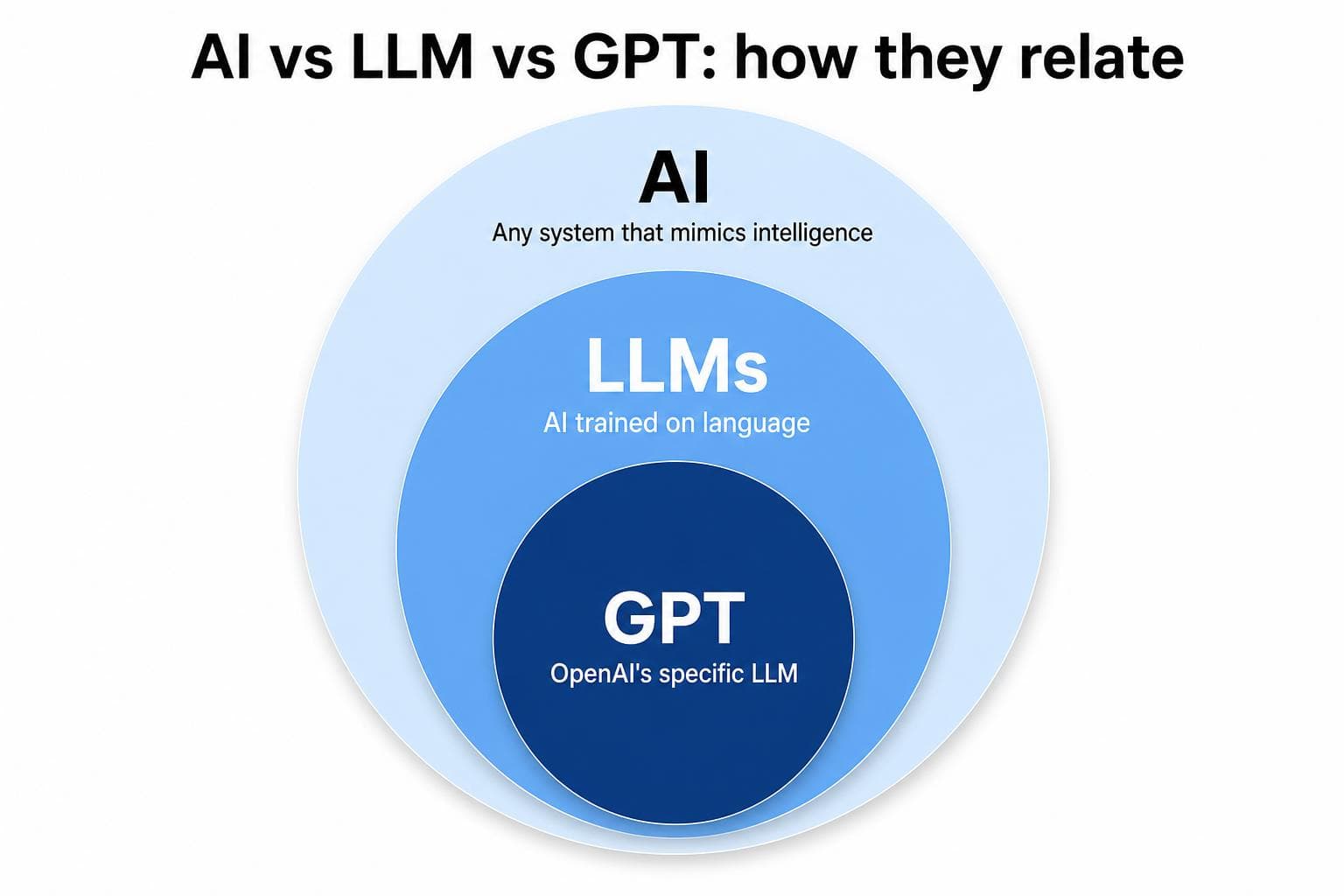
These terms are often used together, but they do not mean the same thing.
- AI (Artificial Intelligence) is the broad field. It covers any system designed to perform tasks that usually require human intelligence.
- LLMs (Large Language Models) are a type of AI trained on massive amounts of text to understand and generate language.
- GPT (Generative Pre-trained Transformer) is a specific type of LLM created by OpenAI.
The hierarchy works like this:
AI is the category.
LLMs are a subset of AI.
GPT is one specific model within LLMs.
So when people talk about using GPT, they’re talking about using one particular language model. The broader AI field includes plenty of other systems that have nothing to do with GPT.
Frequently Asked Questions about GPT
What does GPT stand for?
GPT means Generative Pre-trained Transformer, the model behind tools like ChatGPT.
What does ChatGPT stand for?
ChatGPT stands for “Chat Generative Pre-trained Transformer.” The “Chat” refers to the conversational interface, while GPT is the underlying AI model that generates the responses.
What does GPT stand for in AI?
In AI, GPT stands for Generative Pre-trained Transformer. It’s a class of large language model, a system that has been pre-trained on huge amounts of text and then uses that knowledge to generate original writing in response to a prompt.
What is the difference between AI and GPT?
AI is the broad field of any system that mimics human intelligence. GPT is one specific AI model (a Generative Pre-trained Transformer built by OpenAI). Every GPT is AI, but the reverse isn’t true. Image recognition and recommendation algorithms are examples of AI that have nothing to do with GPT.
Who owns ChatGPT?
ChatGPT is owned and operated by OpenAI, the AI research company that created the underlying GPT models. OpenAI also licenses GPT technology to other companies and platforms. Microsoft is the largest investor and partner.
How is GPT used in content creation?
GPT helps writers brainstorm ideas and produce drafts they can edit quickly.
Is GPT only used by big tech companies?
No. Small businesses and individuals also use GPT for content creation and customer support work.
How accurate are GPT-based translations?
GPT translation is highly accurate for everyday language, though it may miss subtle meanings in complex topics.
Will new GPT versions make a big difference for users?
Yes. Each update improves the model’s skills, so users get better results across writing and chat tasks.
Where can I try GPT tools?
You can use GPT on platforms like ChatGPT and OpenAI’s site, plus tools such as RightBlogger.
Is GPT available in my country?
GPT can be accessed online in most countries, but some regions may have restrictions. Check if platforms like ChatGPT or RightBlogger are available where you live.
Conclusion
GPT stands for Generative Pre-trained Transformer, and each word in the acronym matters. (Building an acronym of your own? Our free acronym generator does the reverse.) The Transformer architecture helps the model read context the way a careful reader would. Pre-training gives it a strong base in language and common topics. The generative step turns that understanding into helpful replies.
Once you see how these pieces fit together, ChatGPT feels less mysterious. It’s a powerful pattern recognizer that writes in clear humanlike language. If you want to put GPT to work for your blog or business, try RightBlogger Chat for free, or learn how to make money with AI using tools powered by GPT.

Article by
RightBlogger Co-Founder, Andy Feliciotti builds websites and shares travel and photography adventures on YouTube and his travel blog.

Automated SEO Blog Posts That Work
Try RightBlogger for free, we know you'll love it.





Leave a comment
You must be logged in to comment.
Loading comments...