How to Write a Blog Post Outline (Step-by-Step + Example)
Use 6–10 question-led H2s with notes that cut drafting time by 30–50%.


I’ve outlined a few thousand blog posts over the past 15 years across ryrob.com, RightBlogger, and a handful of niche sites. The single biggest difference between posts that took 6 hours to write and posts that took 2 is the outline.
Good outlines do two things at once. They give you a structure to write into, which kills the blank-page paralysis. And they bake in the SEO, audience, and flow decisions before you start writing, so you’re not rewriting the whole post when you realize halfway through that the structure doesn’t work.
This guide walks through the 9-step process I actually use, shows a real example outline you can copy, and tells you when it’s faster to skip the manual work and use an AI outline generator instead.
Key takeaways
- A blog post outline is a working document, not a formal essay outline. Bullets, fragments, and notes-to-self are fine.
- Define your reader and your target keyword before you list a single H2. Both decisions shape every section.
- The best outlines treat each H2 as a question your reader is asking. If a section doesn’t answer a real question, cut it.
- Aim for 6-10 H2s, each with 2-4 sub-bullets capturing the proof, examples, or links you’ll reference while drafting.
- If you’re stuck, use an AI outline generator (like RightBlogger’s Post Outline tool) for a first pass, then edit hard.
Blog post outline vs. content brief: what’s the difference?
Quick clarification before we get into the process, because these terms get mixed up constantly.
A content brief is what you (or an editor) hands to a writer before they start. It includes the target keyword, audience, angle, key points to cover, sources to reference, internal links to include, word count target, and tone notes. It’s a project spec.
A blog post outline is the structural skeleton inside the brief (or as a standalone if you’re the writer). It’s the H1, H2s, H3s, and a few sub-bullets per section. A good outline IS the most important part of a content brief, but they’re not the same document.
This guide focuses on the outline itself. If you also need a full brief, the same process applies, just add the audience and tone context up top.
Why outline at all?
Three reasons, in order of how often they pay off:
- It cuts your drafting time by 30-50% because you’re not deciding what to say and how to say it at the same time.
- It catches structural problems early. If two H2s overlap, or your conclusion answers the wrong question, you spot it in 5 minutes instead of after writing 1,500 words.
- It makes the post easier to rank. When you plan keywords, internal links, and FAQ coverage upfront, you stop adding them as awkward retrofits.
The 9-step process for writing a blog post outline
If you’re outlining a brand-new post from scratch, work through these in order. If you’re refreshing an existing post, start at step 6 (main points) and reverse-engineer from the current structure.
1. Start with the reader, not the topic
The very first thing on the page should be one sentence describing who this post is for and what they’re trying to accomplish. Something like: “This post is for a solo blogger publishing 1-2 posts a week who wants to stop staring at the blank Google Doc.”
That sentence will shape every other decision: how technical to get, which examples to use, what to skip, and what to link to. If you can’t write that sentence in under 30 seconds, you don’t know who you’re writing for yet, and the post will read like it.
2. Pick a topic where you can actually win
Not every topic is worth outlining. Before you commit, do a 10-minute reality check. Search the target keyword in Google. Look at the top 5 results. Are they all DR 90+ sites with 5,000-word definitive guides? Is the page-1 average less than 12 months old (meaning Google wants freshness)?
Use tools like Google Trends, Exploding Topics, or our Content Gap tool to find topics where the existing answers are weak. Those are the easiest wins. For broader topic strategy, see our guide to SEO content strategy.
3. Research before you write, not after
Collect your proof first. Stats, real examples, screenshots, quotes from experts, links to studies. Dump them into a scratch doc next to your outline.
Two rules that save hours later: cite as you go (paste the URL next to every claim), and never rely on a single source for a load-bearing claim. If only one site says it, treat it as a hypothesis until you confirm it elsewhere.
4. Frame each main point as a question
Open your outline doc and write your H2s as questions a real reader would type into Google or ask a friend.
“What is X?” “Why does X matter?” “How do I do X?” “What’s the difference between X and Y?” “When should I use X?” Questions force you to commit to answering something. They’re also exactly the format AI Overviews, ChatGPT, and Google’s People Also Ask box reward. You can use our People Also Ask tool to see the real questions Google associates with your topic.
Once your H2s are questions, ask yourself: does this post actually answer all of them? If a section asks a question your post doesn’t answer, cut it. If a real question is missing, add it.
5. Add “future you” notes under each heading
This is the part that turns an outline into a writing accelerator. Under each H2, drop 2-4 sub-bullets capturing:
- The specific statistic, example, or source you’ll reference
- The internal link you want to include (slug or URL)
- The one-sentence “thing this section needs to say”
- Any screenshot, table, or callout you plan to add
Future-you (the one sitting down to draft tomorrow morning) shouldn’t have to re-decide anything. The outline tells them exactly what to write into.
6. Use a narrative arc, not a list of tips
A flat list of 10 tips reads as a checklist. A post with a beginning, middle, and end reads like a story you want to finish.
Order your H2s so each one earns the next. Set up the problem, then the principle, then the practical steps, then the edge cases. If you can swap any two H2s without breaking the flow, you don’t have an arc yet. You have a list.
7. Write the intro and conclusion last
Counterintuitive but it works. You don’t actually know what the post is until you’ve outlined the body. Write the intro promise and the conclusion takeaway only after the rest of the outline is locked.
Your intro should promise a specific outcome and set expectations fast. Your conclusion should recap the most important point and give one clear next step. See our guide on how to end a blog post for the closer patterns that actually convert.
8. Bake in basic SEO before you draft
It’s 100x easier to design SEO into an outline than to retrofit it into a finished draft.
At the outline stage, decide:
- Your primary keyword (should appear in title, URL, H1, first 100 words, and at least one H2)
- 2-4 related keywords from keyword research to use as H2s or sub-bullets
- Which 3-5 internal links you’ll add (and where)
- Whether the post needs an FAQ block, a comparison table, or a downloadable
Once the draft exists, you can also run an AI SEO editor to catch missed keywords, weak headings, and readability issues before publishing.
9. Sleep on it, then review
Whenever possible, outline today and review tomorrow. The break lets you spot gaps, repeats, and weak logic you couldn’t see while you were inside the topic.
If you have a peer or editor, this is the right moment to share the outline. Catching a structural problem in a 30-line outline takes 2 minutes. Catching the same problem in a 2,000-word draft takes 2 hours.
A real example outline you can copy
Theory only goes so far. Here’s what a finished blog post outline actually looks like for a target topic. I’ll use “best AI writing tools for bloggers” as the example.
WORKING TITLE: Best AI Writing Tools for Bloggers in 2026 (11 Tested Picks)
PRIMARY KEYWORD: best ai writing tools for bloggers
RELATED KEYWORDS: ai writing software, ai blog post writer, ai content tools
TARGET READER: Solo blogger or small team publishing 4-12 posts/month, $20-100/mo tool budget
WORD COUNT TARGET: 2,500-3,000 words
INTERNAL LINKS TO INCLUDE:
  /blog/ai-content-creation (in intro)
  /blog/best-autoblogging-tools (related round-up)
  /blog/ai-blogging-mistakes (cautionary section)
  /tool/article-writer (in RightBlogger section)

H1: Best AI Writing Tools for Bloggers in 2026 (11 Tested Picks)

INTRO (100-150 words)
  - Hook: most "best AI writing tools" lists are tool catalogs, not editorial picks
  - Promise: 11 tools I (or RB users) actually use, ranked by what they're best for
  - Skip-if: if you want a single all-in-one suite, jump to #1

H2: What makes an AI writing tool worth using in 2026?
  - 4 criteria: voice control, SEO depth, editing speed, pricing transparency
  - Mention: detection scores DON'T matter (Google has said as much)
  - Internal link: /blog/ai-blogging-mistakes

H2: The 11 best AI writing tools (ranked)
  - H3 for each tool: name, one-line "best for X", screenshot, 100-word review,
    pros (3 bullets), cons (2 bullets), price, link
  - Order: by use case, not by sponsor priority
  - At least 1 tool should be free (ChatGPT free tier, Claude free tier)

H2: How to actually use AI writing tools without sounding like AI
  - 3-step workflow: outline yourself, AI for first draft, edit hard
  - Link to ai-blogging-mistakes for the trope list
  - Mention voice prompts, personal-experience injection

H2: When NOT to use an AI writing tool
  - First-person opinion pieces
  - News commentary
  - Very small niches AI was poorly trained on

H2: FAQs (5 questions from People Also Ask)
  - "Can Google detect AI content?"
  - "What's the cheapest AI writing tool?"
  - "Which AI writing tool is best for SEO?"
  - "Can I use AI for affiliate posts?"
  - "What's the difference between AI writing tools and autoblogging tools?"

CONCLUSION (~120 words)
  - Recap top 3 picks
  - Honest disclosure: I built one of these
  - Next step: try one for two weeks before paying for two
That whole document is maybe 250 words, takes 20-30 minutes to put together, and turns an intimidating 2,500-word post into something you can draft in a few focused sessions. The first version of every post I write at RightBlogger looks something like this before any prose exists.
How long should a blog post outline be?
Short answer: as short as it can be while still being useful when you sit down to draft.
Practical answer: for a 1,500-word post, aim for an outline of 150-250 words (6-8 H2s, 2-3 sub-bullets each). For a 3,000-word post, aim for 300-500 words (8-12 H2s, 3-5 sub-bullets each). If your outline is longer than a quarter of your draft target, you’ve probably started writing prose inside the outline. Pull it back to bullets.
Use an AI outline generator when you’re stuck
The 9-step process above is what I do for posts that matter. For everything else (a quick news take, a low-stakes update post, brainstorming round 1), it’s faster to start with an AI-generated outline and edit it down.

RightBlogger’s Post Outline tool takes a topic or keyword and writes a structured outline in seconds. You can then import it directly into the Article Writer to generate a first draft you’ll edit, or just use the outline as a scaffold for writing yourself.

One important note: don’t treat the AI output as the final outline. Use it as a scaffolding pass. The H2s it suggests are usually fine, but the order, the sub-bullets, and the angle still need a human pass. The outline is where your unique perspective shows up. The post itself just executes on that perspective. After generating, you can also run an SEO report on the eventual draft to catch optimization gaps.
Frequently asked questions
How long should a blog post outline be?
Aim for 6-10 H2s with 2-4 sub-bullets each, or roughly a quarter of your target draft length. A 1,500-word post = 150-250-word outline. A 3,000-word post = 300-500-word outline.
What should I include in each section of the outline?
The point the section makes, the supporting facts or sources you’ll cite, the internal link you want to include, and any visual you plan to add. Treat each sub-bullet as a note to future-you.
Where should I place keywords in my outline?
Primary keyword goes in the title, URL slug, H1, and at least one H2. Related keywords (2-4 of them) work well as H2s or sub-bullet labels. Don’t force a keyword into every heading; that reads as overoptimized.
What’s the difference between an outline and a content brief?
The outline is the structural skeleton (H1, H2s, H3s, sub-bullets). The brief is the wrapper around it (audience, target keyword, word count, tone, sources, deliverable date). If you’re writing for yourself, you mostly just need the outline. If you’re handing it to another writer, you need the full brief.
When should I use an outline generator?
For posts you don’t have strong opinions on yet, for low-stakes update posts, or just for breaking through writer’s block. Start with the Post Outline tool and edit the H2 order, sub-bullets, and angle to add your perspective.
How do I start a blog if I want steady long-term growth?
Start in a tight niche, focus on quality over volume, and outline every post before you draft it. This step-by-step guide on how to start a blog the right way walks through the full setup without shortcuts.
The outline is the post
Most of the work of writing a good blog post happens in the outline. The drafting is just executing on decisions you already made.
If you remember nothing else from this post, remember the order: reader first, topic second, keyword third, structure fourth. Skip any of those and you’ll be rewriting at draft stage.
And if you’re stuck staring at a blank doc right now, our free Post Outline generator will give you a starting scaffold for any topic in about 30 seconds. Edit it, add your voice, and start drafting.
Complete Blog Automation in Minutes
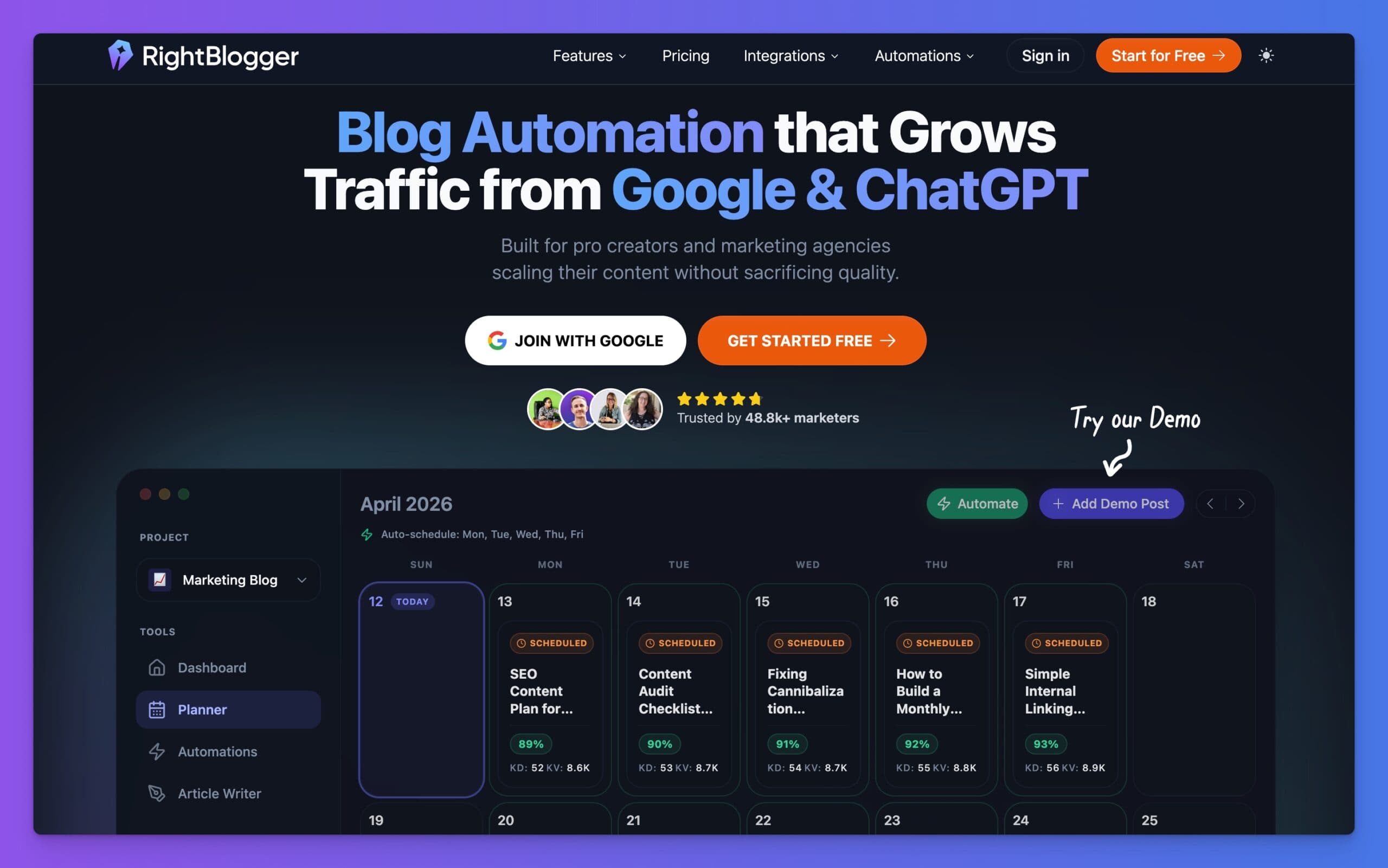
RightBlogger is an AI blog automation tool that helps you research, write, publish, promote, and maintain your blog. Join 50,000+ bloggers, creators, and marketing teams using it to grow traffic from Google and ChatGPT, with 80+ standalone tools, online courses, and a private community included on every plan.

Article by
RightBlogger Co-Founder, Andy Feliciotti builds websites and shares photography and travel adventures on YouTube and his travel blog.




Automated SEO Blog Posts That Work
Try RightBlogger for free, we know you'll love it.





Leave a comment
You must be logged in to comment.
Loading comments...