AI Tools for Marketing Agencies (+5 Ways to Do More with Less)
Five practical workflows, from content gaps to personalized emails, help agencies scale responsibly.


One of the top questions we’ve seen buzzing around marketing forums and across our social media feeds lately is: “What are the top AI tools for marketing agencies, and how do we actually benefit from using AI in our field?” It’s no surprise this question comes up so often: marketing is changing fast.
Apart from the need for constant creative execution, agility and adaptation are also essential traits for any marketing agency that wants to thrive in a future where AI is clearly here to stay.

Customer preferences, markets, and technology all shift quickly, and agencies have to keep up. AI helps by speeding up a lot of the day-to-day work.
If you’re considering integrating AI into your marketing agency’s workflow, you’ve come to the right place.
In this guide, we’ll share the best AI tools for marketing agencies and show how AI can help you do more with less.
The Rise of AI Use Inside Marketing Agencies
At first glance, there seems to be some division within the marketing community regarding the adoption of generative AI. However, upon closer examination, it becomes pretty dang clear that most marketing agencies are embracing AI integration into their workflows, even if it’s somewhat reluctantly.
For example, in July 2022, a few months before ChatGPT launched, Ryan Law, then VP of Content at Animalz, wrote:
“We’re already pretty comfortable with the idea of AI writing advertising material, website copy, product descriptions, and even social media content. But AI can (and will) be used for bigger, more complex parts of content marketing, particularly SEO.”
Another agency, Flying Cat Marketing, summed up its own shift on AI in a LinkedIn post, saying: “At first, there was ambivalence about AI. Then, a full-on embracement of it. And now? A healthy discernment about it.”
Although I consider Flying Cat Marketing among the laggards in generative AI, this statement points to a wider adoption of AI tools for content marketing agencies.
Similarly, Simon Collister, a research and strategy consultant, has said, “From my experience at Unlimited, we’re finding that the day-to-day reality of AI in marketing is very much gravitating towards using it to ‘do less to achieve more’.”
Clearly, if you choose to adopt AI, you’ll be in good company. BUT… you’ll need to do this thoughtfully, tactfully, and in ways that amplify your own strengths as a marketing agency.
Our point of view at RightBlogger is simple: AI works best as your partner and assistant. Marketers who adopt it can do more than those who don’t, and the 2025 Sprout Social Index found that marketers rely on AI to scale their productivity and creativity.
5 Practical AI Use Cases for Marketing Agencies
While the effectiveness of generative AI is widely acknowledged, its applications vary depending on the user. For marketing agencies, here are the five most impactful use cases we’ve seen:
1. Copy & Content Writing
This is the most straightforward and widely embraced use of generative AI. It’s also one of the most popular use cases for marketing agencies that use RightBlogger, particularly with our Article Writer:
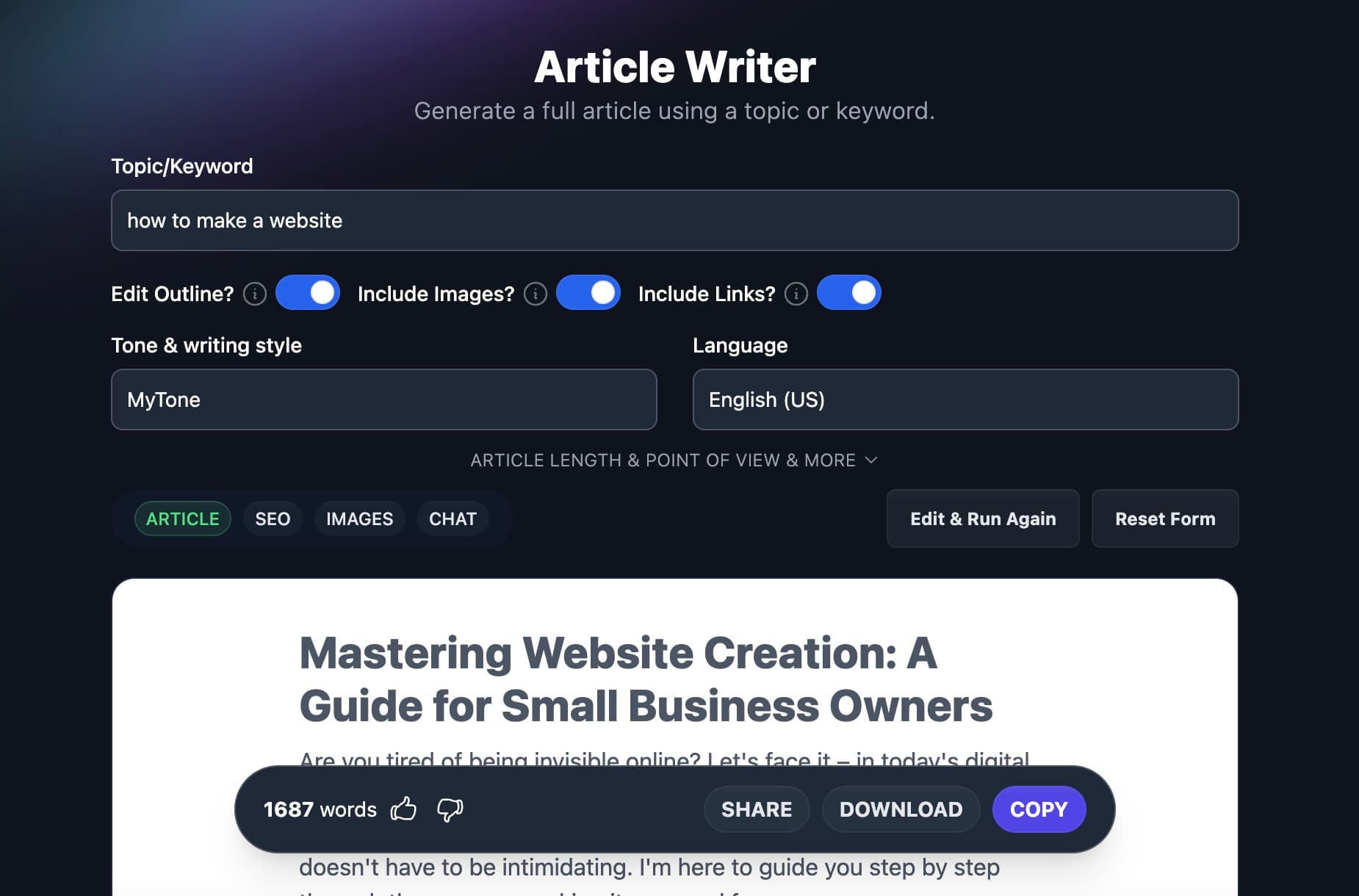
Tasks falling under this umbrella include brainstorming ideas, crafting outlines, generating meta descriptions, composing social media posts, writing blog posts, creating listicles, generating ads, and even proofreading.
Although generative AI proves handy for these tasks, we always recommend that users remain actively involved throughout the entire process. This advice holds particularly true for marketing agencies, which have reputations to uphold.
When using AI to generate long-form articles, pay special attention. AI-generated content may inadvertently contain errors or instances of plagiarism, posing potential risks to your credibility and authenticity.
I like what Victor Ijidola, a content marketer and co-founder of Leaps, said about this:
“My best tip to scale content creation (without sacrificing quality) is to use it to flesh out already established POVs. The general idea of scaling content with AI often comes with the assumption that you can just insert a topic and some context into an AI tool and get a high-quality content piece in return. But at this point, we’ve all used AI long enough to know that’s not true.”
Ijidola added that “the better way is to determine your POV on a topic, create your outline (AI can also do this if given enough context), start writing, and let AI complete your sentences as you go.”
Relying solely on AI to mass-produce articles can hurt both your SEO and your agency’s reputation, so keep a human involved at every stage.
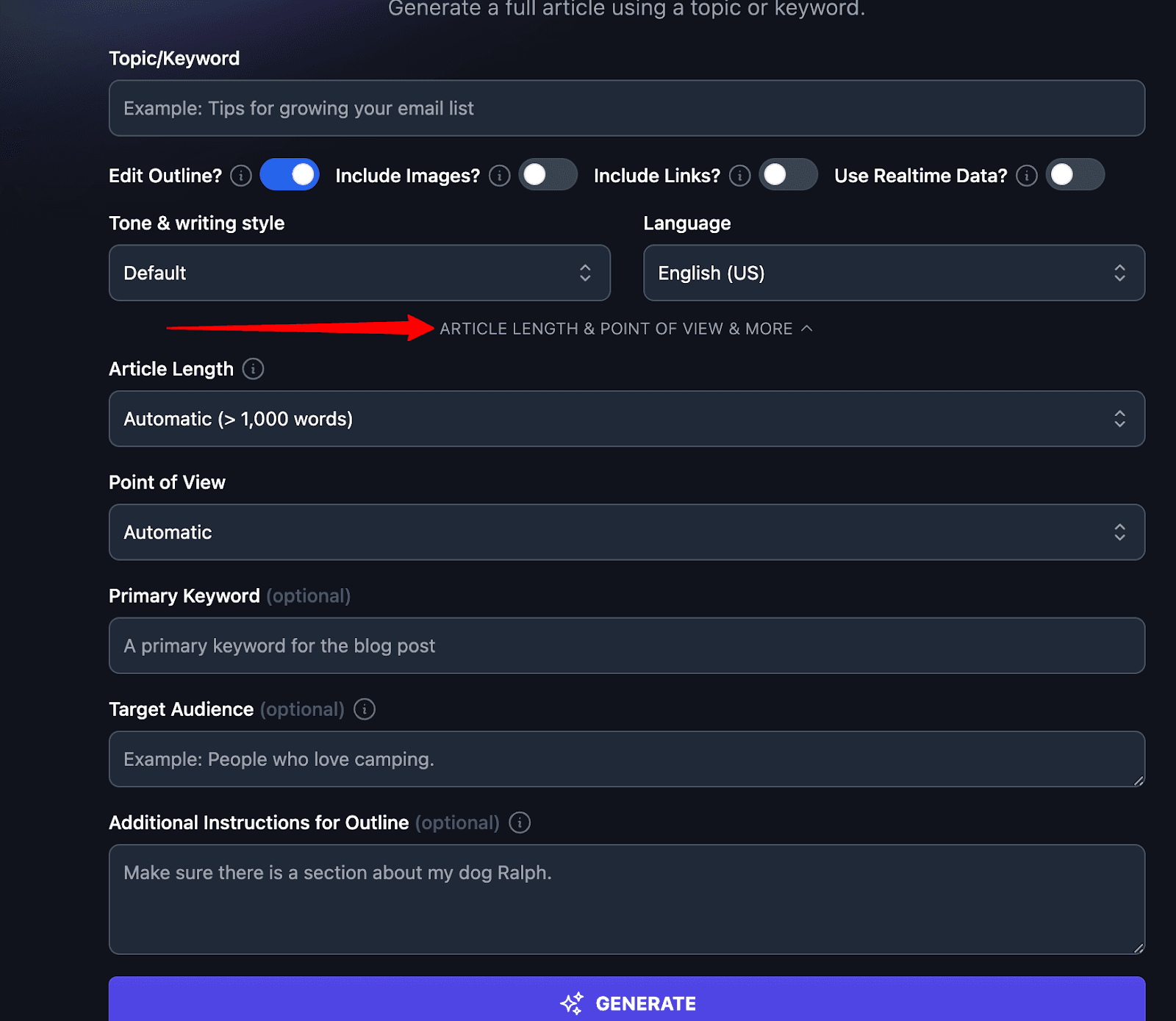
RightBlogger’s Article Writer helps here: its advanced options let you set the point of view and add your own instructions before it drafts, so your perspective is in the piece from the start.
Here are some tips to make the most of generative AI for your copywriting:
- Write clear, precise prompts. General assistants like ChatGPT, Gemini, Claude, and Microsoft Copilot need specific instructions, so it pays to learn how to prompt any AI tool well.
- Verify every claim the AI makes and watch for plagiarism. If it cites a source, check that source yourself.
- Add your own point of view. After all, it’s what your audience is after.
- Have a human editor polish the draft. AI still can’t quite match the finesse of a good editor on flow and tone.
2. SEO & Content Optimization
SEO is one of AI’s strongest applications. Apart from generating SEO-focused outlines and articles, AI tools like RightBlogger can also help with:
- Keyword research
- Topic clustering
- Backlink checking
- Content optimization
- Content gap analysis
While many are familiar with the functionalities of keyword research and backlink analysis, the potential of AI in topic clustering, content optimization, and content gap analysis is still underutilized.
Take topic clustering. Covering a subject in depth, with related articles that link to each other, helps search engines see your site as an authority on that topic.
When a team of HubSpotters tested this approach, they found that the more internal links they added between related pages, the higher those pages climbed in the SERPs. Deciding which articles belong together still takes strategy, though.
With the help of AI, you can complete this process a lot faster.
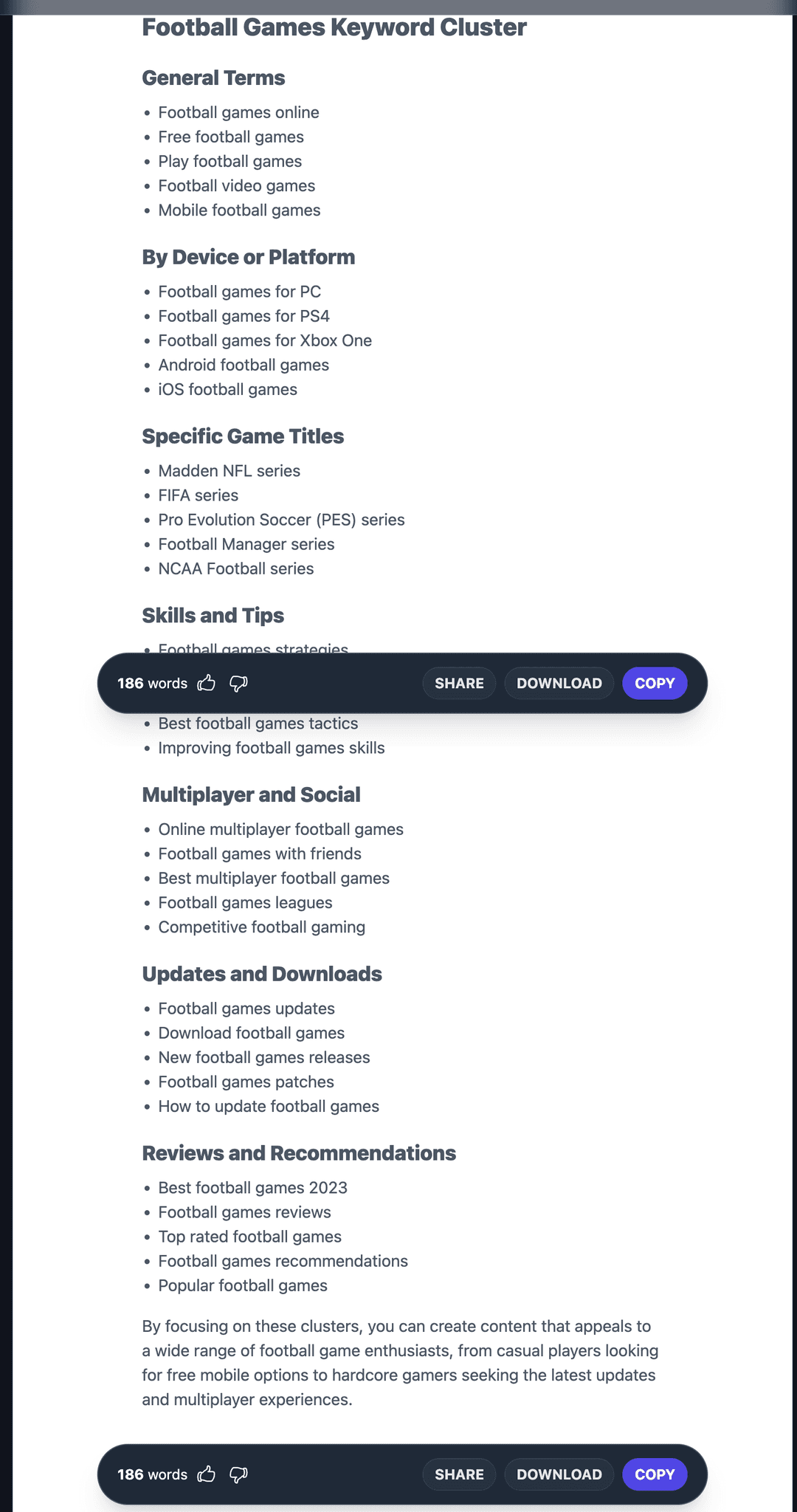
Here’s an example of a keyword cluster developed by RightBlogger, which saved me hours of research and brainstorming.
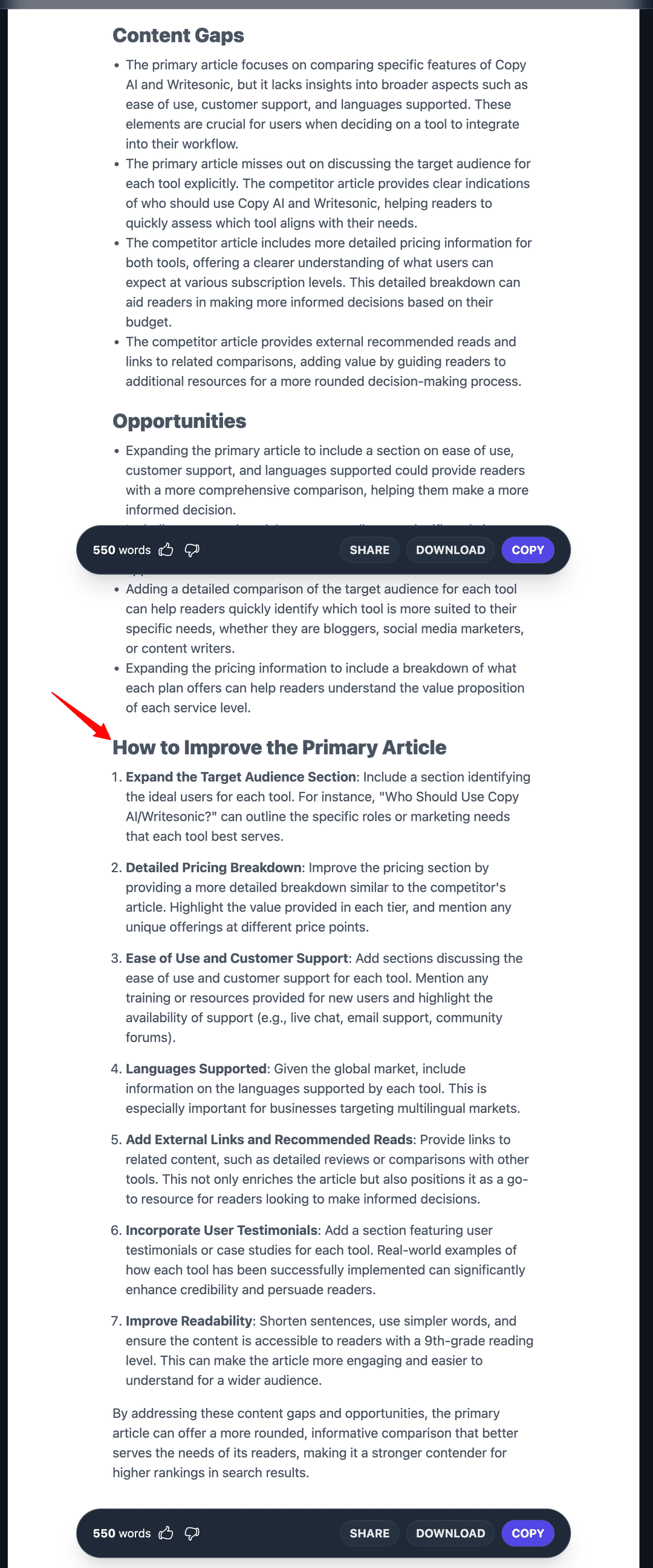
Another strong use case is content gap analysis, which is typically a time-consuming and mentally draining task. A generative AI tool can do this for you in minutes while uncovering insights you might have missed otherwise.
I recently attempted a content gap analysis with RightBlogger, and I was amazed by the recommendations it provided.
Here are some tools that can assist you with this:
- RightBlogger for keyword research, topic clusters, and content gap analysis
- Surfer SEO for optimizing content
3. Email Personalization at Scale
Campaign Monitor reports, citing Aberdeen research, that personalized emails improve click-through rates by an average of 14% and conversions by 10%.
However, many automated email campaigns lack personalization, leading marketers to manually craft their outreach emails.
But now, thanks to AI, we have email tools that can expedite this process. These tools can create targeted lists, craft personalized emails, and automate sending based on schedules.
By pulling in data from different channels, they can segment your audience and tailor emails to each group.
Here are some email tools that can help you:
- Lemlist for finding and verifying leads, personalizing outreach at scale, and running multichannel sequences
- RightBlogger’s Cold Email Generator and Email Subject Line Generator for drafting personalized emails and subject lines
4. Content Creation Workflow Automation
A polished content creation workflow smooths out every step, from brainstorming to hitting the publish button.
In a content strategy setup, a series of tasks are necessary to successfully produce different content formats like blog posts, social media posts, or ad copy.
Here are some ways you can add AI to your workflow as a marketing agency:
- For internal collaboration, AI-powered project management tools like ClickUp and Nifty can automate task assignments, progress tracking, and project updates, so work keeps moving without constant check-ins.
- For performance reporting, pair Google Search Console with a tool that watches rankings for you. Surfer, for example, tracks AI visibility and flags rank drops on its Standard plan and up, which speeds up client reporting.
5. Ideation & Brainstorming
AI tools can rapidly generate multiple variations of concepts within seconds, allowing you to brainstorm and test new ideas at a conceptual stage.
This accelerates the ideation process and provides a wealth of creative options to explore.
I find RightBlogger’s ideation tool extremely useful for this.
5 Best AI Tools for Marketing Agencies
Generative AI tools vary in their capabilities, with some tailored for specific tasks while others excel in different areas. While there are AI tools designed for bloggers and AI for content agencies, our focus here is on AI tools specifically crafted for marketing agencies.
For a broader list sorted by category, see our roundup of AI marketing tools worth using. Here are our top picks for agencies:
1. RightBlogger
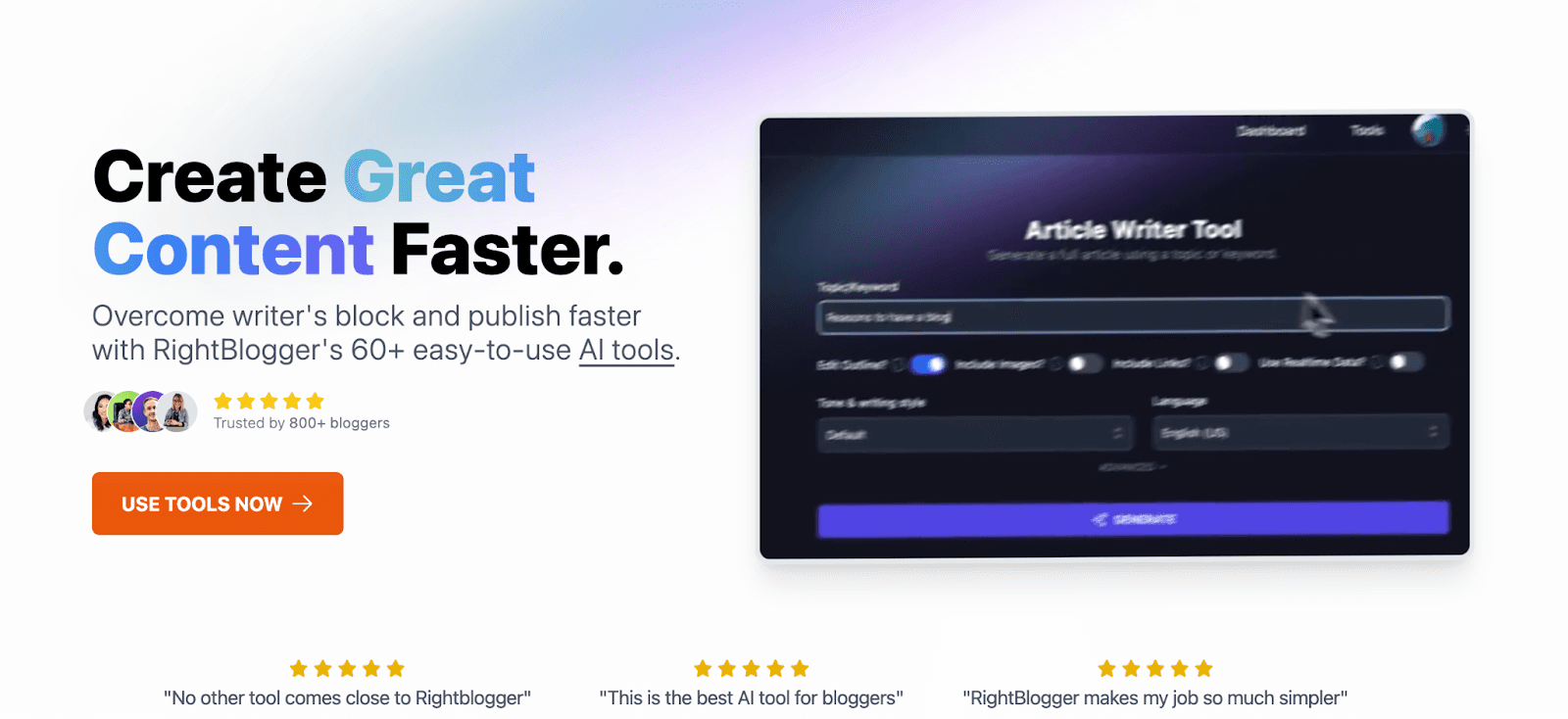
RightBlogger is our own AI platform for bloggers, marketers, and agencies, so weigh this pick accordingly. It has 90+ tools across SEO, blogging, sales, productivity, and social media. The ones agencies get the most from are the Article Writer (set the tone, point of view, and target audience, then edit the outline before it drafts), keyword research, content gap analysis, Keyword Cluster for planning content calendars, and Video to Blog Post for repurposing client videos.
Pricing: There’s a free plan with 2,000 AI words a month. Paid plans are $49/mo (Solo), $69/mo (Pro), or $199/mo (Agency) billed annually, each with unlimited AI words, a 7-day free trial, and a 30-day money-back guarantee.
Skip if: most of your client work is short ad copy or paid campaigns. It’s built around blog content and SEO, so a copy-focused tool like Anyword is a closer fit.
2. Anyword
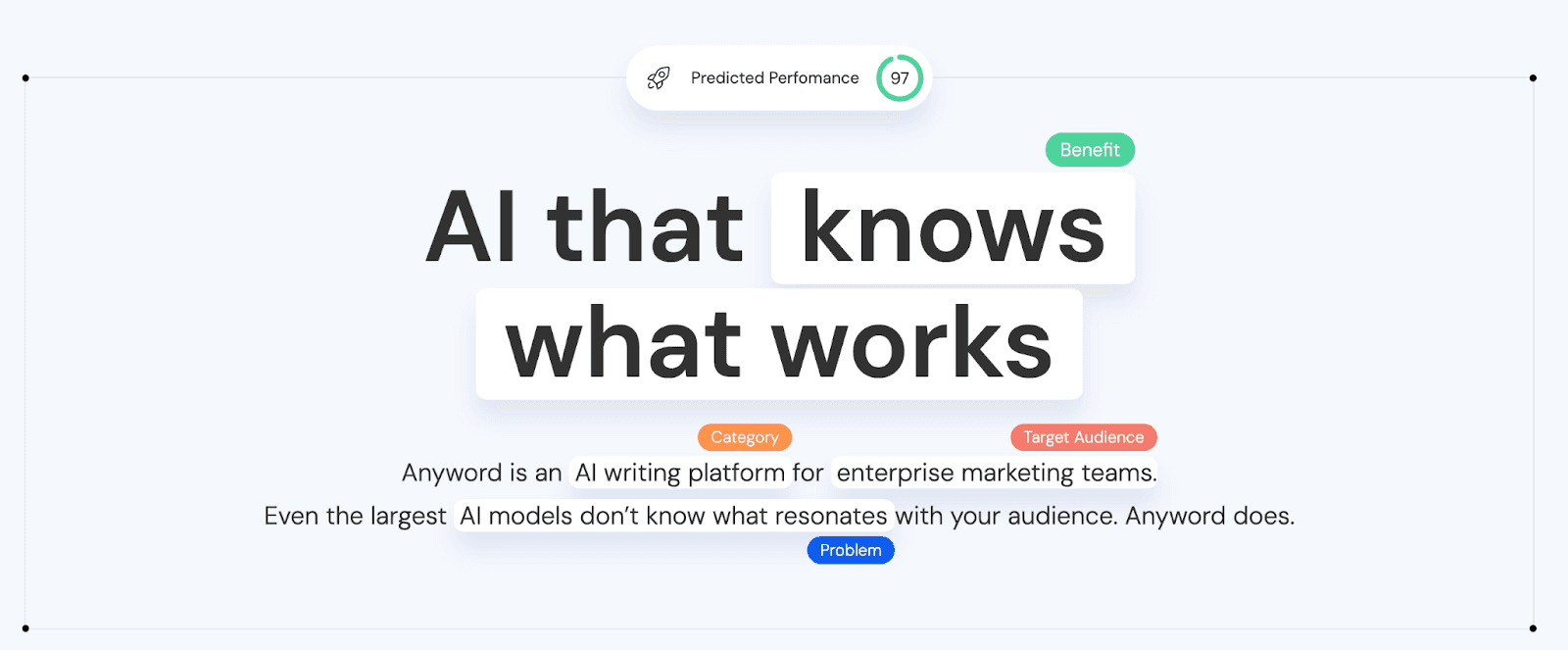
Anyword is an AI writing assistant tailored specifically for ad agencies and copywriters. If you’re in search of a generative AI tool specializing in crafting concise copy aimed at driving conversions, think ads, product descriptions, and social media posts, Anyword is your go-to solution.
Its standout feature is performance prediction: Anyword scores your copy before you publish, so you can see which version is likely to perform best. Plans also include a brand voice and 100+ marketing templates.
Pricing: Plans start at $49/mo, with a 7-day free trial.
Skip if: you mainly need long-form blog posts rather than short conversion copy.
3. ChatGPT
ChatGPT is OpenAI’s general-purpose AI assistant. Beyond conversation, it can research, analyze files, create images, and take on multi-step projects in ChatGPT Work.
While it proves valuable during the research phase, its effectiveness hinges on the quality of your prompts.
Because it’s general-purpose, getting client-ready output takes more prompting and setup than it would with a tool built for a specific job.
Pricing: There’s a free plan with limits on uploads and image creation. Plus is $20/mo.
Skip if: you want templates and workflows built for agency deliverables out of the box.
4. Describely

Formerly Copysmith, Describely writes SEO-optimized product descriptions. If you own an eCommerce storefront and want to generate product descriptions in bulk, Describely can help.
Pricing: Pay as you go at $0.75 per product for up to 500 products, with custom pricing for larger catalogs.
Skip if: your clients don’t sell physical products online.
5. Jasper
Jasper is built for marketing teams that need on-brand content at scale. Brand Voice and Knowledge (part of Jasper IQ) keep output consistent, and its agents cover core marketing workflows.
The Pro plan includes 2 Brand Voices, 5 Knowledge assets, and 3 Audiences, which works for an agency with a few clients. Larger rosters will need the custom-priced Business plan.
Pricing: Pro is $59/mo billed annually or $69 billed monthly, with a 7-day free trial.
Skip if: you manage many client brands and don’t want to move to custom enterprise pricing.
Which AI Tool Should Your Agency Pick?
Most agencies end up using two or three of these. The short version:
- RightBlogger for blog content, SEO research, and repurposing at scale
- Anyword for short, conversion-focused copy with performance predictions
- ChatGPT for research, brainstorming, and general tasks
- Describely for bulk product descriptions
- Jasper for brand-governed content across a handful of client brands
We’re more than a little biased, so take this with a grain of salt: if most of your client work is blog content and SEO, RightBlogger covers the most ground in one plan. You can try its tools for free, and paid plans start at $49/mo billed annually with a 7-day free trial and a 30-day money-back guarantee.

Article by
Ali Faagba is a content strategist and writer for B2B SaaS companies, with a focus on AI, marketing automation, and sales.


Automated SEO Blog Posts That Work
Try RightBlogger for free, we know you'll love it.





Leave a comment
You must be logged in to comment.
Loading comments...